You know that feeling when you meet someone at a networking event in Dubai, exchange cards, and the first thing they do when they get to their car is pull out their phone and search your name? It’s a bit like a first date. You want to look your best.
But instead of a customized suit or a firm handshake, your “first impression” is a collection of blue links, some old photos from a family brunch in 2018, and maybe a LinkedIn profile you haven’t touched since the pandemic.
Let’s be real: in 2026, your name will be a search term. Whether you like it or not, you are an entity in a database. If you’re a founder, a creative, or a consultant, your Google search results are your digital resume. If you aren’t managing those results, someone else or worse, a random algorithm is doing it for you.
Honestly, I’ve seen brilliant CEOs lose deals because their search results were a mess. It’s not just about ego; it’s about trust. This is where Personal Branding SEO comes in. It’s the art of making sure that when someone looks for you, they see exactly what you want them to see.
The New Currency of Authority
The Concept: Reputation Meets Visibility
Personal Branding SEO is the bridge between who you say you are and who Google says you are. For years, people treated Search Engine Optimization as something for businesses like ranking for “best pizza in Dubai” or “luxury real estate.” But as the lines between founders and their companies blur, your personal search results have become the ultimate gatekeeper.
Think of it this way: visibility without a good reputation is a disaster, but a reputation that no one can find is a tragedy. Personal Branding SEO ensures that your expertise isn’t just known in your immediate circle, but is discoverable by the entire digital ecosystem.
The “Entity” Shift: You are Not a Keyword
Here’s the thing: Google has changed how it “thinks.” It no longer just looks for words on a page. It looks for Entities. In the Google Knowledge Graph, an entity is a unique thing or concept that is well-defined. You are an entity. For example Zumeirah is an entity. The relationship between you two is a data point.
When you search for a person and see that clean box on the right (the Knowledge Panel), that’s Google recognizing an entity. To rank #1 in 2026, we have to stop thinking about “ranking for a name” and start thinking about “defining an identity” that the algorithm can categorize with 100% certainty.
Why it matters for Founders: The “Founder Effect”
Have you heard of the Founder Effect? Statistics from 2024 and 2025 suggest that a strong personal brand for a founder can increase a company’s conversion rate by up to 33%. People don’t buy from faceless corporations anymore; they buy from people they trust.
When a founder has a high-authority search presence, it lends “transitive trust” to the business. If you, as the leader, are seen as an expert, your company is viewed as the expert solution. It’s a powerful psychological shortcut.
Our Perspective in Personal Branding
At Zumeirah, we don’t just see this as a technical task. It’s a design challenge. We believe in marrying high-end aesthetics with deep search visibility. A beautiful website that doesn’t rank is a vanity project. A high-ranking site that looks like it was made in 2005 is a credibility killer. We aim for that sweet spot where technical SEO meets world-class design.
To help you navigate this shifting landscape, We’ve broken down the process into a clear, actionable roadmap. Think of this as your personal blueprint for digital dominance in 2026.
We’re going to walk through everything from auditing your current digital footprint and building a bulletproof technical foundation to mastering the nuances of “Entity SEO” and leveraging the latest AI-search trends.
By the time we’re finished, you’ll know exactly how to claim your spot at the top of the search results and stay there.
Here is the 7-step strategy we are going to explore to transform your name into a high-ranking authority:
- Step 1: The Identity Audit & Brand SERP Analysis.
- Step 2: Architecture of the “Home Base” (Technical Foundation).
- Step 3: Mastering “Entity SEO” & Schema Markup.
- Step 4: The Content Pillar & Cluster Strategy.
- Step 5: Digital PR & The “Backlink Ecosystem”.
- Step 6: Generative Engine Optimization (GEO) for AI Search.
- Step 7: Reputation Management & SERP Domination.
So get ready to deep dive into all these steps. Let’s discuss all of them to grow your personal brand with the help of SEO in 2026. Let’s go.
Step 1: The Identity Audit & Brand SERP Analysis
The “Incognito” Diagnostic
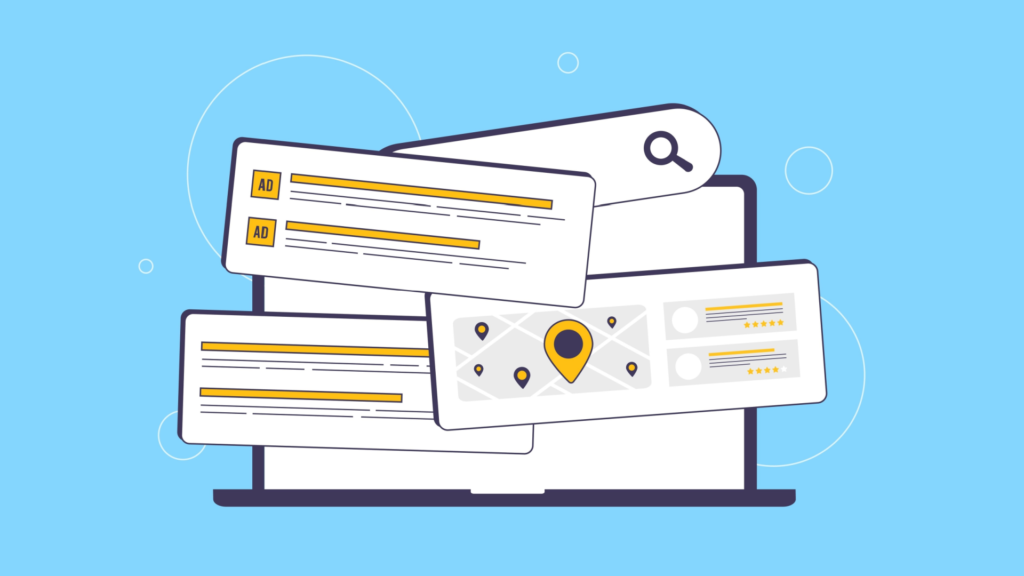
Before we can fix the future, we have to face the present. Open a private or “Incognito” browser window. Why? Because your normal browser knows you too well. It shows you what it thinks you want to see. You need a “clean slate” view.
Type your name. Scroll through the first three pages. What do you see?
- Is your LinkedIn profile at the top?
- Is there a weird news article from 2012 about a marathon you didn’t finish?
- Are there images of you that look professional, or are they cropped photos from a wedding?
Competitor Benchmarking
You aren’t just competing against yourself; you’re competing for attention within your niche. Look up the top three people in your industry. How do their search results look? Do they have a Knowledge Panel? Do they have “People Also Ask” sections under their names? Analyzing their digital footprint gives us a roadmap of what’s possible and where the gaps are.
Identifying the “Ghost Effect”
The “Ghost Effect” is when your name is overshadowed by someone else. Maybe you share a name with a famous footballer or a niche scientist. If you’re a “Mark Smith” in Dubai, you have a mountain to climb. But even then, we can use “contextual modifiers” linking your name specifically to “Web Design” or “Zumeirah” to carve out your own territory.
We also look for “outdated profiles.” That old About.me page or a Twitter/X account you haven’t used in five years is just noise. It’s a “ghost” of your former self that needs to be updated or buried.
Action Item: Creating a “Brand SERP Map”
I want you to make a simple list.
- Current Rankings: List the top 10 links for your name.
- Desired Rankings: What should be there? (Your personal site, your bio, your LinkedIn, a major interview, etc.)
- The Gap: Identify what needs to be created or pushed down.
Step 2: Architecture of the “Home Base” (Technical Foundation)
Domain Strategy: Where do you live?
The biggest question I get is: “Should I buy MyName.com or just use a page on my company site?”
Honestly, it depends. If you want to build a long-term legacy separate from your current business, get the personal domain. But for most founders, having a dedicated, highly optimized “Founder” or “Leadership” page on Zumeirah.com is actually better. Why?
Because Zumeirah.com already has authority. It’s easier to rank a new page on an established site than to start a new domain from zero.
Core Web Vitals: Speed is a Trust Signal
Let’s talk technical for a second. Google uses “Core Web Vitals” to measure user experience. If your bio page takes 3 seconds to load on a 5G connection in Dubai, users will bounce. And if they bounce, Google thinks your content isn’t helpful.
A 1-second load time isn’t just a “best practice”
I almost said it! it’s a requirement for modern authority. It shows you care about the user’s time.
Advanced Metadata: Value Over Names
Your Title Tag shouldn’t just be “Mohammad Safwan.” That’s boring. It should be a value proposition.
- Bad: Mohammad Safwan – Home
- Good: Mohammad Safwan | Expert Web Designer & Founder of Zumeirah Dubai
The meta description is your “elevator pitch.” You have about 155 characters to convince someone to click. Use them wisely. Mention your specific niche and your biggest achievement.
UI/UX for Trust: The Luxury of Space
At Zumeirah, we’re big on “Quiet Luxury” in design. This means lots of white space, high-resolution photography, and clean typography. When someone lands on your page, they should feel the quality before they read a single word. A cluttered, busy page screams “desperate.” A clean, professional page screams “authority.” This reduces your bounce rate, which you guessed it like is a massive SEO signal.
Step 3: Mastering “Entity SEO” & Schema Markup (The Developer’s Edge)
The Knowledge Graph Blueprint
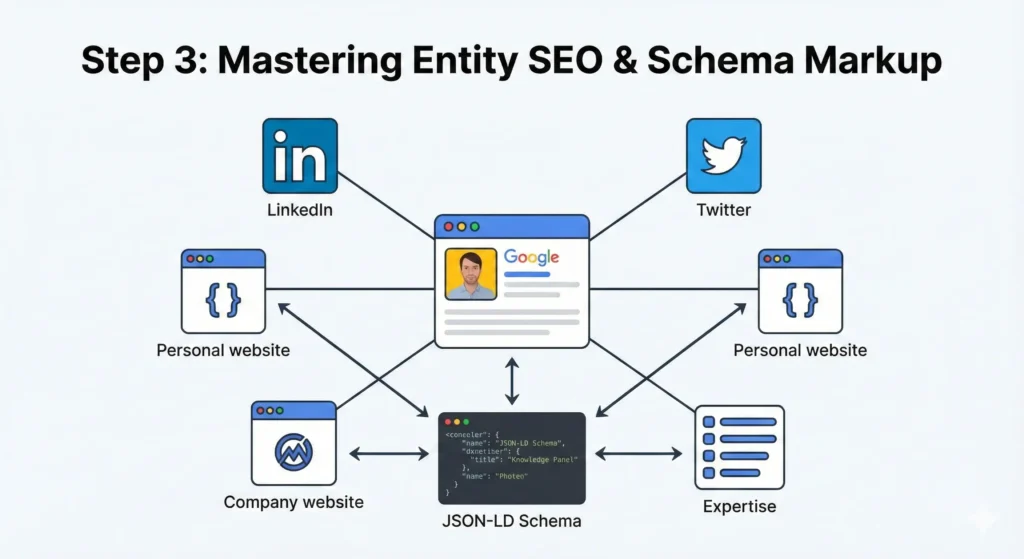
Remember the “librarian” analogy? Google is trying to connect the dots. You need to provide the “links” between data points. Entity SEO is about moving away from “string” (letters) to “things” (concepts).
If you want Google to know you’re the owner of your brand, you have to state it in a way that’s machine-readable.
Person Schema Implementation
This is where we get into the code. JSON-LD is the preferred format. You need to implement Person schema on your home base page. A crucial field is sameAs. This is where you list all your official profiles (LinkedIn, X, Instagram, etc.). It’s like telling Google: “These five different profiles are actually the same entity.”
Another important one is knowsAbout. This allows you to list your expertise areas. By explicitly stating you “know about” Web Design or SEO in UAE, you’re helping the algorithm categorize you correctly.
Professional Service Schema
Doesn’t matter where you are based in, You should also use Professional Service or Local Business schema to link your personal authority to your personal brand physical presence. This helps with local search.
When someone in your locality searches for your niche, Google can see the connection between your expertise and your agency’s location.
Action Item: Claiming Your Knowledge Panel
If a Knowledge Panel already exists for you, claim it! There’s a small link at the bottom that says “Claim this knowledge panel.” You’ll have to go through a verification process (usually showing ID and proof of social media ownership). Once you own it, you can suggest changes to the photos and the bio. It’s the ultimate piece of digital real estate.
Step 4: The Content Pillar & Cluster Strategy
Defining Your Keywords
You don’t just want to rank for your name. You want to rank for the reason people search for you.
- Primary Keyword: Your Name
- Secondary Keywords: “Web Design Expert,” “SEO Consultant Dubai,” “Luxury Branding Specialist.”
We create content that targets these secondary keywords while keeping your name as the central theme.
Thought Leadership: The 2,500-Word Power Post
Forget about 500-word “updates.” In 2025, Google wants depth. We recommend creating “Power Posts” like comprehensive, 2,500+ word articles on topics that nobody else is covering with enough detail.
Instead of writing “How to do SEO,” write “The Complete Evolution of Search in the UAE: 2020-2025.” This shows you aren’t just a practitioner; you’re a historian and a visionary of your craft.
The “Multimedia Loop”
Dwell time (how long someone stays on your page) is a huge factor. If you have a 3,000-word article, most people won’t read every word. But if you embed a 2-minute video of yourself explaining the core concept, or a podcast clip from an interview, you keep them on the page. This “loop” signals to Google that your content is high-value.
Frequency vs. Quality
You know what? Honestly, posting once a week is a waste of time if the content is “fluff.” I’d rather you publish one “Masterpiece” article a month or something so good that people bookmark it and share it than four mediocre posts that disappear into the noise. Quality is the only way to win in the age of AI-generated content.
Step 5: Digital PR & The “Backlink Ecosystem”
The Authority Flywheel
Backlinks are like votes of confidence. But not all votes are equal. A link from a local Dubai business journal or a major industry site like Search Engine Land is worth a thousand links from random blogs.
When you get featured in the news or on a podcast, you’re creating an “Authority Flywheel.” The more high-authority sites link to you, the more Google trusts your personal brand, which makes it easier for you to rank for future keywords.
Strategic Guest Posting
Don’t just guest post anywhere. Find niches where your name adds real value. If you’re an expert in luxury web design, look for high-end lifestyle or business publications in the UAE. When you write for them, make sure your “Author Bio” links back to your optimized “Home Base” page at Your Brand Home Page.
Social Signal SEO
LinkedIn is your best friend. In 2026, LinkedIn profiles often rank in the top 3 results for any professional name. Why? Because LinkedIn has massive Domain Authority. Make sure your profile is optimized. Use your keywords in your headline.
More importantly, engage with others. The more “social signals” (likes, shares, comments) your content gets, the more relevant you appear to search engines.
Unlinked Mentions
Sometimes, people talk about you but don’t link to you. This is a missed opportunity. You can use tools to track mentions of “Brand Name” or your name. When you see one, a polite email asking for a link can turn a simple mention into a ranking boost.
Step 6: Generative Engine Optimization (GEO) for AI Search
Ranking in Gemini & ChatGPT
We’re no longer just in the era of “Search.” We’re in the era of “Answers. I mean Generative Engine Optimization” When someone asks an AI, “Who is a top web designer in Dubai?”, the AI looks for “grounded” sources.
To be cited by AI, your content needs to be “fact-dense.” Avoid vague language. Use specific numbers, dates, and proper names. AI loves clear, declarative statements.
Conversational Optimization
Think about how people talk to AI. They ask questions. “What is the best way to…?” or “Who can help me with…?” Your content should mirror these natural language queries. Using H2 or H3 headers that are phrased as questions is a great way to “catch” these AI-driven searches.
The Power of Citations
AI models are trained on data. The more you appear in “Top Lists,” directories, and authoritative publications, the more likely the AI is to recommend you. It’s about building a “consensus” across the web that you are the expert in your field.
Step 7: Reputation Management & SERP Domination
The “Total Control” Strategy
The goal isn’t just to be #1. The goal is to own the first page. Imagine if results 1 through 8 are all things you control:
- Your Personal Site / Brand Bio
- Your LinkedIn
- Your X (Twitter) Profile
- A YouTube Channel
- An interview on a major news site
- Your Instagram (with professional content)
- A Medium blog
- A Crunchbase or industry profile
When you own the page, there’s no room for “noise.”
Negative SEO Defense
Sometimes, things go wrong. A bad review or an old, irrelevant article can pop up. The best defense is a “High-Authority Offense.” By creating more high-quality, optimized content, you “push down” the negative results to page two or three. People rarely look past the first page, so “burying” bad content is often more effective than trying to get it deleted.
The Role of Social Media
In 2026, search results are visual. Google often pulls in a “Social Carousel” showing your recent posts from X or Instagram. This is “real-time SEO.” It shows that you are active and current. Even if someone doesn’t click, seeing your active presence builds trust instantly.
FAQ: Frequently Asked Questions about Personal Branding SEO
How long does it take to rank for my own name? Typically, you’ll see movement in 4 to 12 weeks. If you have a very common name, it might take longer. If your name is unique, we can often clear the first page in less than a month.
Do I need a separate website for my personal brand? Not necessarily. A dedicated, highly optimized “Founder” page on Your Brand Website can be even more powerful. It leverages the existing trust of the agency domain while keeping everything under one roof.
What is the most important SEO signal for a personal brand? E-E-A-T: Experience, Expertise, Authoritativeness, and Trustworthiness. Google isn’t looking for “tricks”; it’s looking for proof that you are a real person with verifiable knowledge.
How does AI (like Gemini) change personal branding? AI prioritizes “Entities” over keywords. If you haven’t established yourself through Schema and high-authority mentions, the AI might not recognize you as a “Trusted Expert.”
Can I use AI to write my personal branding content? You can use it for research and outlines, but your “Unique Perspective” and personal stories are what rank. Google rewards original thought. AI “fluff” rarely makes it to the top.
How do I get a Google Knowledge Panel? By being a recognized entity. This happens through consistent Schema markup, being cited in authoritative publications, and having a strong, consistent digital footprint across multiple platforms.
Conclusion
In a world of AI-generated noise and digital clutter, Authentic Authority is the ultimate SEO strategy. You can’t fake expertise, and you can’t hide from the algorithm.
At Zumeirah, we believe that your personal brand is your most valuable asset. It’s the legacy you build every time you publish an article, give an interview, or launch a project. By following this 7-step roadmap, you aren’t just “doing SEO” like you’re taking control of your story.
The digital landscape of 2026 will be competitive, but it’s also full of opportunity for those who are willing to be seen. Owning your search results isn’t just a technical goal; it’s a commitment to your own professional excellence.
Ready to make your mark? The first step is simple: look at your results and decide today that they should be better.