
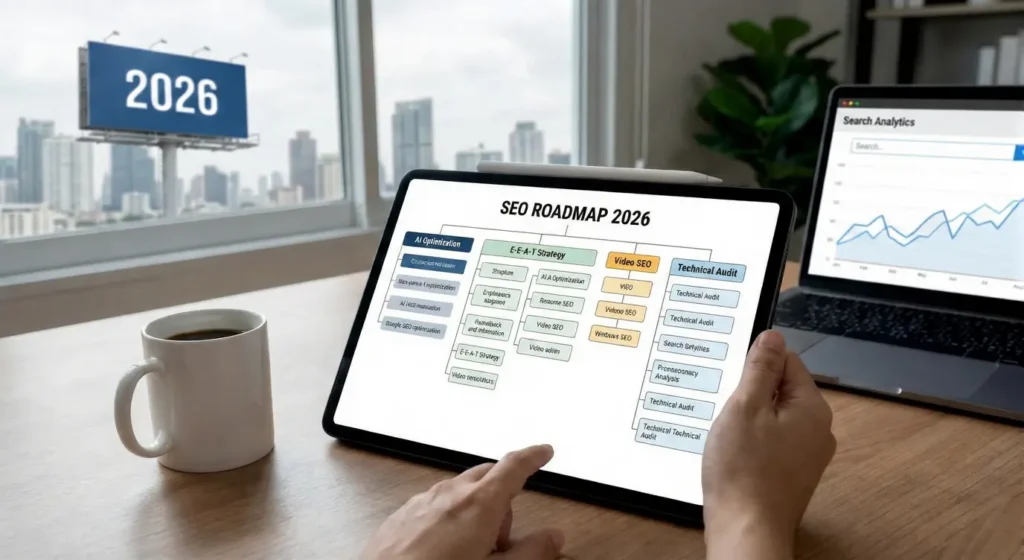
In 2026, organic search is projected to drive 53% of all website traffic, but here’s the thing like it only happens if you have a solid plan in place.
Honestly, if you’re still trying to wing it by throwing keywords at a wall and hoping they stick, you’re essentially playing a game of chance where the house always wins. And by “the house,” I mean Google’s latest AI-driven algorithms.
Let’s be real for a second. The search landscape has shifted beneath our feet. We aren’t just competing with other blogs anymore; we’re navigating a world of AI Overviews and those pesky zero-click searches where users get their answers without ever leaving the results page.
It’s enough to make any business owner feel a bit overwhelmed, right? You might be wondering, “Is SEO even worth it anymore?”
The answer is a loud, resounding yes. But the old ways? They’re done.
To actually move the needle this year, you need a modern SEO roadmap. Think of it as a living document that guides your brand through the noise of 2026.
It’s not just about “ranking” for a term but it’s about understanding what your audience is actually trying to solve when they type a query into a search bar or better yet, when they ask their AI assistant for help. Whether they’re looking for a quick fix or a deep-dive solution, your strategy has to be there to meet them.
In this guide, I’m going to share the expert process for building a winning SEO roadmap that doesn’t just look good on paper but actually delivers.
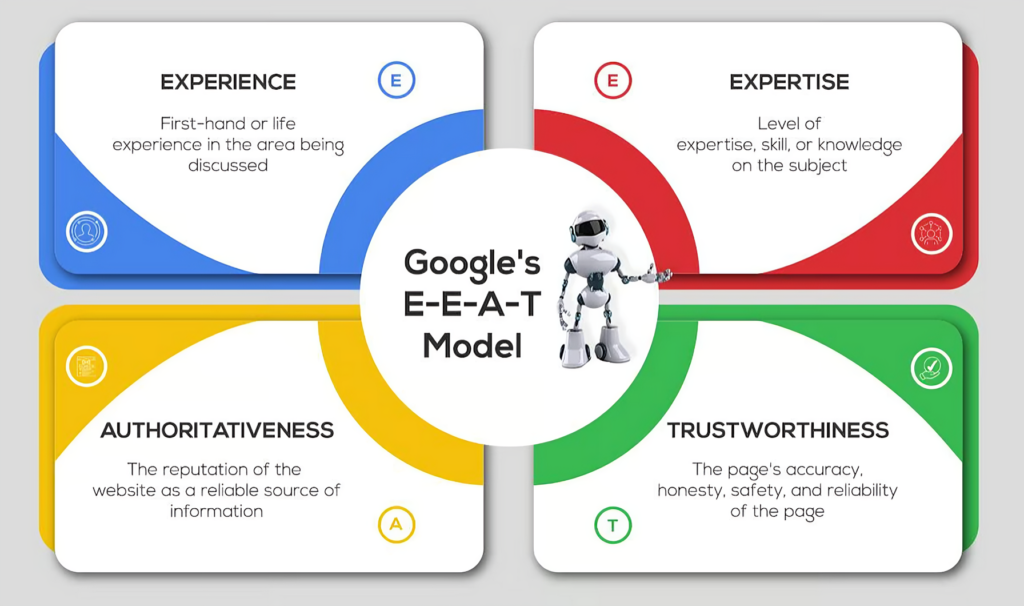
We’re talking about a framework tailored for the current trends: AI search visibility, E-E-A-T (that’s Experience, Expertise, Authoritativeness, and Trustworthiness, for the uninitiated), and a laser focus on ROI.
Why bother? Because when you get this right, you don’t just see a spike in a graph. You see more qualified leads, better conversion rates, and a brand that people actually trust.
You know what? It’s about building a search engine powerhouse that works for you 24/7. So, let’s get into how you can stop guessing and start dominating the first page.
What Exactly is an SEO Roadmap?
SEO Roadmap is one of those terms that gets tossed around in marketing meetings like confetti, but it’s actually the backbone of any successful digital presence.
At its simplest, it is your tactical GPS. It’s a strategic document that maps out your specific goals, the exact tasks needed to get there, who is doing what, and crucially when it’s all going to happen.
Without it, you’re just doing “stuff” and hoping the search engines notice. And let’s be real, Google is far too busy for that in 2026.
SEO Roadmap Strategy vs. Roadmap
A common mistake I see all the time? Confusing a roadmap with an SEO strategy. They aren’t the same thing, not by a long shot. Think of your strategy as the “what and why.” It’s the big-picture vision for instance, “we want to become the top authority for web design in Dubai because our conversion rate is higher there.”
The roadmap, on the other hand, is the “how and when.” It’s the nitty-gritty: “In Week 3, we are fixing the Schema markup on the service pages.” Strategy is the dream; the roadmap is the work.
One Size Doesn’t Fit All
Depending on who you are, your roadmap might look a bit different. A small business might operate on a quarterly cycle, focusing on quick wins and local visibility.
Meanwhile, an enterprise-level SEO roadmap is a massive, multi-departmental beast that often looks ahead a full year, juggling technical debt with global content scaling.
| Feature | Small Business Roadmap | Enterprise Roadmap |
| Duration | Quarterly (3 Months) | Annual (12 Months) |
| Primary Focus | Local SEO & Quick Wins | Scalability & Technical Debt |
| Team Size | 1-2 People | Cross-departmental |
Whether it’s a simple spreadsheet or a complex Gantt chart, the goal remains the same: clarity. You want to look at a single page and know exactly where your organic growth stands today and where it’s headed tomorrow.
Why You Absolutely Need a Winning SEO Roadmap in 2026
If you’re still trying to “do SEO” by checking off a generic list of tasks you found on a forum three years ago, I have some news for you: the game has changed.
Honestly, in 2026, flying without a roadmap isn’t just risky but it’s essentially an expensive hobby. Search is no longer about those ten blue links we used to obsess over. It’s dynamic, it’s conversational, and it’s increasingly crowded by AI.
Without a clear path, you’re not just competing against other websites; you’re competing against Google’s own AI systems. And you know what? A solid SEO roadmap is the only thing standing between your brand and digital invisibility.
Cutting Through the AI Search Noise
AI Overviews (formerly SGE) and zero-click searches have completely flipped the script. In fact, early 2026 data shows that AI summaries now appear in over 25% of all searches.
If your strategy hasn’t evolved to capture these “citations” and “AI mentions,” you’re losing a massive chunk of your potential audience before they even have a chance to click.
A roadmap helps you prioritize Generative Engine Optimization (GEO). Instead of just chasing keywords, you’re building a structure that AI models like Google Gemini and ChatGPT can actually understand, digest, and recommend. It’s about being the source, not just another search result.
Learn: Keyword Research with Google Search Console (2026 Guide)
The Rise of “T” in E-E-A-T
We’ve all heard about Experience, Expertise, and Authoritativeness. But in 2026, Trust is the undisputed heavyweight champion. With the internet being flooded by AI-generated fluff, search engines are desperately looking for “human signals.”
- Do you have real-world case studies?
- Is your author a verified expert in the Dubai market?
- Are you citing original data?
An expert-led roadmap ensures these trust signals are baked into your site’s DNA, not just added as an afterthought. It shifts your focus from “how much content can we produce?” to “how much value can we prove?”
Numbers Don’t Lie: The Expert Advantage
You might be wondering if all this planning actually pays off. Based on current industry benchmarks, businesses that follow a structured, expert-designed roadmap see between 20% to 50% higher organic growth compared to those that wing it.
When you prioritize high-impact tasks like fixing technical “AI-readiness” issues or building topical authority then you aren’t just getting more traffic; you’re getting better traffic. You’re reaching people at the exact moment they’re looking for a solution.
Comparison: Site Performance With vs. Without a Roadmap
| Feature | Sites Without a Roadmap | Sites With a Winning Roadmap |
| Traffic Growth | Stagnant or erratic (-5% to +2%) | Consistent & Scalable (+20% to +50%) |
| AI Visibility | Rarely cited in AI Overviews | Frequently cited as a trusted source |
| Ranking Stability | Drops during every core update | Resilient; often gains after updates |
| Resource Usage | Wasted on low-impact tasks | Optimized for high-ROI activities |
| Conversion Rate | Low (targeting broad, irrelevant terms) | High (targeting specific user intent) |
At the end of the day, an SEO roadmap isn’t just a document; it’s your competitive edge. It allows you to pivot when the next algorithm hits and ensures every dollar you spend on content is actually working to grow your bottom line.
The Trends That Are Redefining Your 2026 Strategy
A roadmap that worked eighteen months ago is likely gathering digital dust right now. Why?
Because the goalposts haven’t just moved they’ve been replaced. If you want your SEO roadmap to actually deliver results this year, you have to account for the massive shifts in how people (and machines) find information.
Let’s look at what is actually moving the needle for our clients at Zumeirah and across the global search landscape.
1. The Era of AIO and GEO
You might have heard of SEO, but have you met its cousins, AIO (AI Optimization) and GEO (Generative Engine Optimization)?
Google is no longer just a librarian pointing to a book; it’s an assistant summarizing the book for you.
To win here, you need to make your data “machine-readable.” This means leaning heavily into structured data (Schema markup) and encouraging user-generated content. Why?
Because AI models love consensus. If your customers are talking about your incredible web design services in Dubai across various platforms, AI is far more likely to cite you as a trusted authority.
2. Double Down on E-E-A-T
Experience, Expertise, Authoritativeness, and Trustworthiness. It sounds like a mouthful, but it’s the heartbeat of 2026 search. With the web being flooded by cheap, AI-generated filler, Google is desperately looking for a “human” behind the screen.
Are you building brand sentiment? Are your backlinks coming from real, high-traffic sites or just empty directories? Authenticity is the new currency. If your content doesn’t feel like it was written by someone who has actually done the work, it’s going to sink. Honestly, it’s that simple.
3. Surviving the Zero-Click Reality
It’s a bit frustrating, isn’t it? You work hard on a page, and then Google just puts the answer in a Featured Snippet, and the user never clicks. But don’t panic.
The trick is to target “micro-intents.” Instead of just providing a definition, provide a unique perspective or a video that adds value beyond the quick answer.
If you can dominate the conversational queries the way people actually talk to their phones you’ll still capture that brand awareness even without the traditional click.
Learn : Personal Branding SEO Strategy: 7 Steps to Rank #1 for Your Brand
4. Local Presence and the Power of Video
For businesses in competitive hubs, local schema is your best friend. But there is a new player in town: Video SEO.
Have you noticed how many search results now feature a short video clip right at the top? If a video isn’t part of your roadmap, you’re essentially ignoring a massive chunk of the “search real estate.”
People want to see who they are dealing with before they pick up the phone.
5. Topic Clusters and “Social Search”
The days of writing one-off blog posts are over. You need to build “topic clusters” dense, interconnected hubs of information that prove you own a subject.
But here is a curveball: your audience is also searching on TikTok and Instagram. A modern roadmap shouldn’t just focus on Google; it should look at how your content can live and breathe across the entire social search ecosystem.
Expert Tip: The “Trend Readiness Audit”
Before you start writing, ask yourself: If I were an AI assistant, would I find this page useful enough to recommend? Check your structured data, look at your page speed (especially on mobile), and see if your “Expertise” is actually visible on the page. If it looks like a generic template, it’s time for a refresh.
5 Ways to Bake These Trends into Your Roadmap
- Audit your Schema: Ensure every service page has specific, up-to-date markup.
- Plan for Video: Add one short, helpful video to your top five performing pages.
- Encourage Reviews: Create a system to get real customer feedback on third-party sites.
- Build a Pillar Page: Pick one core topic and create five related sub-topics to link back to it.
- Optimize for Voice: Answer three “How-to” or “What is” questions directly at the top of your articles.
The Step-by-Step Blueprint: Building Your SEO Roadmap
So, you’re ready to stop guessing and start growing. Building an SEO roadmap isn’t about making a long list of things you should do; it’s about deciding what you’re actually going to do to move the needle.
Honestly, the most successful roadmaps I’ve seen aren’t the ones with the most tasks they’re the ones with the most focus.
Let’s walk through the expert way to build yours, 2026 style.
Step 1: Define Your SEO Goals and Objectives
You can’t hit a target you haven’t set. Every winning roadmap starts with a “Why.” Are you looking for raw traffic, or are you looking for the kind of leads that actually turn into revenue for your business in Dubai?
- The SMART Framework: Don’t just say “I want more traffic.” Say, “I want to increase organic leads by 30% within six months.” That is Specific, Measurable, Achievable, Relevant, and Time-bound.
- Align with Business KPIs: If your business goal is to sell more high-end web design packages, your SEO goal shouldn’t just be ranking for “free web tips.” You need to align your search objectives with your bank account.
- Brainstorming for 2026: Sit down with your team and ask: “How ready are we for AI Overviews?” If Google’s AI is summarizing your competitors instead of you, that needs to be a goal right there.
Step 2: Conduct a Comprehensive SEO Audit
Here is where we roll up our sleeves. You can’t plan the future if you don’t know the “health” of the present.
- Technical Audit: Use tools like Semrush or Ahrefs to find the “invisible” killers. We’re talking crawl errors, broken links, and those all-important Core Web Vitals. If your site takes three seconds to load on a 5G connection in the middle of Dubai Mall, you have a problem.
- Content Audit: Look for “keyword cannibalization” that’s when two of your own pages are fighting for the same spot on Google. It’s like arguing with yourself in public; nobody wins. Identify gaps where your competitors are ranking and you aren’t even in the room.
- Backlink & UX Audit: Check for “toxic” links that might be dragging you down. But also, look at your user behavior in Google Search Console. Are people landing on your site and immediately hitting the “back” button? That’s a signal that your UX (User Experience) needs a roadmap of its own.
Step 3: Identify Opportunities and Tasks
Now, we turn those audit findings into a “To-Do” list. But here’s the thing: in 2026, we focus on AI-friendly terms.
- Researching for the Future: Look for long-tail, conversational keywords. People don’t just type “SEO” anymore; they ask, “How do I create an SEO roadmap for a small agency?”
- The Big List: Write down everything. On-page fixes, new content ideas, technical patches, and off-page outreach.
| Task | Category | Potential Impact | Effort Level |
| Fix Schema for AI Citations | Technical | High | Medium |
| Write 5 “Topic Cluster” Articles | Content | High | High |
| Optimize Images for Mobile | Technical | Medium | Low |
| Clear Keyword Cannibalization | On-Page | High | Low |
Step 4: Prioritize with the Impact-Effort Matrix
You can’t do everything at once. This is where most people fail then they try to climb the whole mountain in a day. Instead, use an Impact-Effort Matrix.
- Quick Wins (High Impact, Low Effort): Do these today. Fixing a broken meta description or a slow-loading image can give you an immediate boost.
- Big Bets (High Impact, High Effort): These are your 2026 game-changers. Building out a massive pillar page or overhaul of your site’s architecture.
- The 2026 Twist: Prioritize anything that helps with “AI Citations.” If adding FAQ Schema takes an hour but helps you show up in a Gemini summary, move it to the top of the list.
Step 5: Set Timelines, Milestones, and Resources
A roadmap without a date is just a wishlist. Break your year into quarters (Q1, Q2, etc.).
- Assign Owners: Who is responsible? If “everyone” is doing it, nobody is doing it.
- Budgeting: Do you need a writer? A developer? A subscription to a new AI tool?
- The Algorithm Buffer: Always leave a little “breathing room.” Google loves to drop a core update right when you think you’re finished. Give yourself a 10% time buffer for unexpected changes.
Step 6: Build the Document
Finally, put it somewhere people can actually see it. Whether you love Google Sheets, Asana, or a Trello board, the format matters less than the visibility.
Pro Tip: Use a Kanban view (the “To Do,” “Doing,” “Done” columns). It’s incredibly satisfying to move a “High Impact” task into the “Done” column and watch your traffic graphs start to climb.
Putting the Plan into Action: Implementation and Monitoring
You know what? Creating the document is the easy part. The real challenge and where most businesses in Dubai and beyond falter is in the execution.
An SEO roadmap isn’t a “set it and forget it” kind of deal. It’s a living, breathing framework that requires a bit of grease to keep the gears turning. If you just leave it sitting in a folder, you’re essentially buying a gym membership and never showing up.
Why SEO is a Team Sport
Here’s the thing: SEO doesn’t happen in a vacuum. To actually see those rankings climb, you need to involve everyone from your marketing gurus to your dev team.
If your developers don’t understand why you’re asking for a certain schema update, it might sit at the bottom of their backlog for months.
- Stakeholder Buy-in: Make sure your leadership understands that SEO is a long game. It’s about building an asset, not just buying an ad.
- The Content-Dev Bridge: Use your roadmap to bridge the gap. When a writer knows a technical fix is coming, they can prepare the content to take full advantage of it the moment it goes live.
Tracking the Numbers That Actually Matter
In 2026, we aren’t just looking at raw traffic anymore. With the rise of AI-driven search, “vanity metrics” can be a bit of a trap. You need to be looking at Google Analytics 4 (GA4) and Search Console through a different lens.
- AI Citation Frequency: How often is your brand being mentioned in Google’s AI Overviews or Gemini responses? This is the new “Position 1.”
- Engagement Rate: If people land on your page and stay there, Google sees that as a massive trust signal. If they bounce in two seconds, you’ve got a problem.
- Conversion ROI: At the end of the day, traffic is great, but revenue is better. Track how many of those organic visits are actually turning into leads or sales for your business.
The Review Cycle: Stay Agile or Get Left Behind
The search world moves fast. I usually recommend a Monthly Check-in to look at the immediate impact of your tasks and a Quarterly Deep Dive to see if your overall direction still makes sense.
Did Google drop a new “Core Update” that changed how they view local SEO? You need to be ready to pivot. If a specific topic cluster isn’t performing, don’t be afraid to shift your resources to a different “big bet.”
Pivoting for 2026 Changes
Honestly, the biggest mistake you can make is being too rigid. As new AI features roll out like advanced “agentic” search where AI actually performs tasks for the user your roadmap needs to adapt.
Maybe that means shifting from written blogs to more structured, “machine-readable” data or increasing your focus on video SEO.
The goal isn’t to follow the plan perfectly; the goal is to get the result. If the landscape changes, change your route. That’s why we call it a roadmap, not a set of tracks.
Common Mistakes to Avoid in Your 2026 SEO Roadmap
Look, I’ve seen a lot of roadmaps in my time. Some are beautiful works of art that belong in a museum, while others look like they were scribbled on a napkin during a lunch break.
But here is the thing: a pretty document doesn’t guarantee rankings. Even the most seasoned pros can fall into traps that make their hard work completely invisible to modern search engines.
If you want to stay ahead of the curve in 2026, you need to be aware of these common pitfalls. Honestly, avoiding these is half the battle.
1. Treating AI Like a Passing Fad
If your roadmap doesn’t mention Generative Engine Optimization (GEO) or AI Overviews, you’re essentially planning for the internet of 2019.
I’ve seen businesses spend thousands on traditional backlinks while completely ignoring the structured data that helps AI assistants actually “read” their site.
Learn: Link Building in 2026: The Proven Roadmap to #1 Rankings
If ChatGPT or Gemini can’t figure out who you are and what you do, you’re missing out on the fastest-growing segment of search traffic. It’s not just about “keywords” anymore; it’s about becoming a verifiable entity that machines trust enough to cite as a source.
2. Getting Stuck in “Technical Debt”
Here’s a real-world example of a failure I see all too often: A company spends six months fixing minor CSS errors or chasing a perfect 100/100 PageSpeed score while their competitors are building out massive, high-authority topic clusters.
Don’t get me wrong site speed matters. But if you prioritize low-impact technical “polishing” over creating content that proves your expertise, you’re going to lose.
It’s like cleaning the windows of a shop that has no products on the shelves. You need to focus on the tasks that actually move the needle for your revenue.
3. The “Set It and Forget It” Mentality
Search in 2026 is incredibly dynamic. If your roadmap is a rigid 12-month plan with no room for a pivot, you’re in trouble.
Let’s say Google drops a major core update in March that completely changes how they view “experience” signals. If you’re stuck following a plan made in January, you’re basically walking into a storm without an umbrella.
4. Publishing “Unchecked” AI Fluff
We’ve all been there the temptation to use AI to churn out twenty blog posts in an afternoon is real. But honestly, Google is getting much better at spotting content that lacks that “human touch.”
I once saw a brand lose 40% of its organic traffic in a single month because they replaced their expert writers with raw, unedited AI output.
The content was grammatically perfect, but it was hollow. It lacked original data, real-world examples, and that subtle emotional nuance that readers (and search engines) crave.
Expert Advice: How to Stay on the Right Path
- Audit for E-E-A-T monthly: Don’t just assume your site looks trustworthy. Check your author bios, your citations, and your “About” page.
- Prioritize by ROI, not by “Checklist”: Before you start a task, ask: “Will this help a customer trust us more, or will it help an AI agent cite us?” If the answer is no, move it down the list.
- Keep your roadmap “Loose”: I like to plan in detail for the next 90 days and leave the rest of the year as a broader “vision.” This gives you the flexibility to adapt when the next big trend hits.
Success Stories: Real-World SEO Roadmaps in Action
It’s one thing to talk about theory, but it’s another thing entirely to see these strategies move the needle in the real world.
Honestly, there is nothing quite as satisfying as watching a flatline traffic graph finally start to point toward the sky. Let’s look at a couple of brands that took the leap, ignored the “old” rules, and built their 2026 roadmap around where the puck was actually going.
Case 1: The E-commerce Pivot – 40% Growth via AI Optimization
An mid-sized fashion retailer was struggling. They had thousands of products, but their organic traffic had plateaued because they were essentially invisible in Google’s new AI Overviews. Their “old” roadmap was just more of the same: more product descriptions, more generic backlinks.
The Fix: We helped them pivot their roadmap to focus on Generative Engine Optimization (GEO). Instead of just writing for humans, we made their data “machine-readable.”
- They implemented advanced ProductGroup Schema so AI assistants could understand variations in color and size.
- They shifted their blog strategy from “Top 10 Trends” to “Problem-Solving Guides” that answered specific conversational queries like “What should I wear for a summer wedding in Dubai?”
The Result: Within four months, they weren’t just ranking; they were being cited as a top source in over 30% of relevant AI search summaries.
This led to a 40% increase in organic revenue, because the traffic coming from AI was much higher intent. You know what? They weren’t just getting clicks; they were getting customers.
Case 2: The Local Hero – Dominating with Video and Local SEO
A local specialized clinic in Abu Dhabi was being outspent by massive hospitals with huge marketing budgets. They felt like they couldn’t compete. But here is the thing: the big guys were slow.
Learn: Why is Local SEO important for businesses in 2026
The Fix: Their new roadmap prioritized Hyper-Local Authority and Video SEO.
- They started producing short, 60-second “Expert Insight” videos for every service page, answering the most common questions patients asked in the clinic.
- They optimized their Google Business Profile with fresh, weekly updates and localized schema that targeted specific neighborhoods, not just the whole city.
The Result: Those videos started appearing at the top of the search results, often above the “big” hospital websites.
By focusing on E-E-A-T (showing real doctors giving real advice), they saw a 55% jump in appointment bookings directly from search. They didn’t need a million-dollar budget; they just needed a better map.
Key Lessons Learned from the Front Lines
- AI is an opportunity, not a threat: The brands that won were the ones that made it easy for AI to find and recommend them.
- Authenticity is the ultimate “hack”: In a world of AI fluff, real expert videos and genuine customer reviews are worth their weight in gold.
- Specificity beats scale: You don’t need to rank for everything. You just need to rank for the things that make people pick up the phone.
The Tools of the Trade: Your 2026 SEO Tech Stack
You wouldn’t try to build a house with just a hammer, right? The same logic applies to your SEO roadmap.
In 2026, the traditional toolkit has evolved into what many of us call the “Discovery Stack.” To stay ahead of the curve especially with the rise of AI-driven search you need tools that don’t just track keywords, but actually understand how machines are perceiving your brand.
Learn: Traditional SEO vs. AI SEO: Best Way for #1 Rankings in 2026
Essential Tools for Every Specialist
- The Big Three (Semrush, Ahrefs, Screaming Frog): Honestly, these remain the undisputed heavyweights.
- Semrush now features a dedicated “AI Visibility Toolkit” that tracks your share of voice across Google’s AI Overviews.
- Ahrefs has launched “Brand Radar,” which monitors how often your brand is mentioned across the web—a crucial signal for modern authority.
- Screaming Frog is still the go-to for technical deep dives, especially for auditing the “AI-readiness” of your site’s code.
- ZipTie & Otterly AI: These are the new kids on the block. They specialize in Generative Engine Optimization (GEO), showing you exactly which parts of your content are being cited by ChatGPT, Gemini, and Perplexity.
Free Resources to Get You Started
You don’t always need a massive budget to make an impact.
- Google Search Console (GSC): Still the gold standard for “pure” data. Use the new “AI Citations” tab to see which queries are driving users to your site via AI summaries.
- HubSpot’s AI Search Grader: A fantastic free tool that gives you a quick snapshot of your brand’s sentiment and visibility across various LLMs.
Staying Sharp: 2026 Expert Recommendations
The search landscape moves fast, so staying educated is part of the roadmap itself.
- Listen: The AI Search Report by Nathan Gotch and EDGE of the Web are currently the best podcasts for keeping your finger on the pulse of 2026 trends.
- Read: SEO 2026 by Adam Clarke is a must-read for understanding how semantic search and brand associations have replaced traditional keyword stuffing.
Look, we have covered a lot of ground here. Building a winning SEO roadmap in 2026 isn’t about being a robot or trying to “game” a system that is increasingly powered by sophisticated AI.
It’s about being the most helpful, most authoritative human in the digital room. If you follow the steps we’ve walked through setting those sharp SMART goals, performing a deep-dive audit, and prioritizing tasks based on what actually drives revenue you are already miles ahead of the competition.
The search landscape is changing faster than most people can keep up with. Those AI Overviews and conversational queries aren’t just a trend; they are the new reality.
But you know what? That’s actually a massive opportunity if you’re prepared. When you focus on building real authority and making your site technically flawless, you’re creating a brand that machines want to recommend and humans want to trust. It’s no longer about just being found; it’s about being the source of truth in a sea of generic, uninspired content.
As we move further into 2026 and beyond, the key is to stay agile. The roadmap you build today might need a tweak in three months when the next major algorithm shift happens, and that is perfectly okay. In fact, it’s expected.
The future of search belongs to those who are curious enough to learn, bold enough to lead, and authentic enough to stand out. It’s a long game, for sure, but the view from the top of the search results is well worth the effort.
You’ve Got Questions? I’ve Got Answers.
When I’m talking to clients about building an SEO roadmap, a few specific questions tend to pop up time and time again. It makes sense SEO in 2026 feels a bit like trying to hit a moving target while blindfolded. Let’s clear up some of the most common points of confusion so you can move forward with total confidence.
What is the actual difference between an SEO strategy and a roadmap?
This is the one people get hung up on the most. Think of your strategy as your “North Star” it’s the big-picture vision and the “why” behind your efforts. For example, “we want to dominate the luxury real estate niche in Dubai.”
The roadmap, however, is the actual turn-by-turn directions. It’s the “how” and the “when.” It lists specific tasks like “Week 2: Audit all property page schema” or “Month 2: Launch the video series on neighborhood guides.” Strategy is the dream; the roadmap is the schedule.
How long should an SEO roadmap be?
There’s no one-size-fits-all answer here, but for most businesses, I recommend a 12-month outlook broken down into 90-day sprints. Why?
Because search moves fast. If you try to plan every single detail for 12 months out, you’ll likely be rewriting it by month four because of an algorithm update. Plan the vision for the year, but keep the specific tasks focused on the next three months.
What are the top SEO trends for 2026?
The big ones right now are Generative Engine Optimization (GEO) that’s making sure AI assistants like Gemini can find and cite you and a massive emphasis on E-E-A-T.
Google is looking for original data, expert voices, and real human experiences to counter the flood of AI-generated content.
If your roadmap doesn’t include video SEO and local schema, you’re missing a huge piece of the puzzle.
How do I prioritize tasks in my roadmap?
I always use the Impact-Effort Matrix. You want to find those “Quick Wins” tasks that are low effort but have a high impact on your rankings (like fixing broken redirects or optimizing page titles).
Once those are out of the way, you move on to the “Big Bets” that require more resources but drive long-term growth. If a task is high effort and low impact, honestly? Just cross it off the list.
Can small businesses create effective SEO roadmaps?
Absolutely. In fact, small businesses need roadmaps even more than the giants do because their resources are limited.
A small business roadmap usually focuses on hyper-local SEO and specific long-tail keywords where you can realistically outrank the big players.
You don’t need a million-dollar budget; you just need to be more strategic with the time you have.