
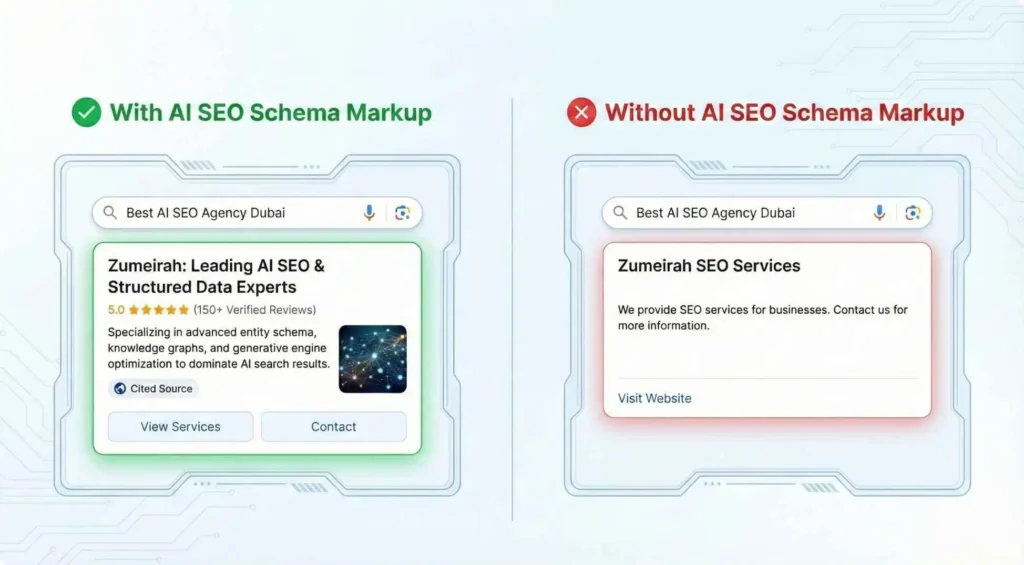
If you’re still thinking about SEO as a game of “ranking #1 on Google,” you’re already living in the past. We’ve moved way beyond the era where a few backlinks and some clever keyword placement could carry a brand.
In 2026, the search landscape feels more like a conversation than a library. Between Google’s AI Overviews, the rise of Gemini, and ChatGPT Search literally redefining how people find answers, the goalposts haven’t just moved but they’ve been replaced entirely.
You know what? The real battle isn’t for the top of the page anymore. It’s for the citation.
When an AI agent summarizes a topic for a user, it needs a source it can trust. If your website is just a mess of unstructured text, these LLMs (Large Language Models) are basically guessing what you do.
And when AI guesses, it hallucinates. That’s where AI SEO Schema Markup comes in.
Think of it as the “machine-readable” blueprint of your business. It’s the difference between being a ghost in the machine and being the primary source of truth that every AI assistant wants to quote.
What exactly are we talking about here?
Let’s break it down without the fluff. AI SEO is the practice of optimizing your content so it’s easily digestible by generative engines. Schema markup, on the other hand, is the specialized code (JSON-LD) you hide in the backend of your site to tell search engines exactly what they’re looking at.
When you combine them, you get a powerful strategy that tells Google: “This isn’t just a blog post and it’s a verified guide written by Mohammad Safwan, who founded Zumeirah, an agency with these specific credentials.”
Here you’re connecting the dots for the AI. You’re making it impossible for the machine to ignore you.
Why this matters right now
Here’s the thing and it’s a bit of a hard pill to swallow like most “SEO experts” are still using basic plugins that spit out generic, flat schema.
That might have worked in 2022, but today? It’s just noise. To actually future-proof your site for 2026, you need to go deep.
We’re talking about Entity Linking, Nested JSON-LD, and E-E-A-T verification that bridges the gap between your website and the global knowledge graph.
In this guide, I’m going to walk you through the advanced SEO strategies we use at Zumeirah to turn “invisible” websites into “authority” hubs.
We aren’t just looking for rich results or star ratings (though those are nice). We are aiming for total AI dominance ensuring that when a user asks a question in your niche, the AI doesn’t just answer; it cites you.
What is AI SEO Schema Markup and Why It Matters
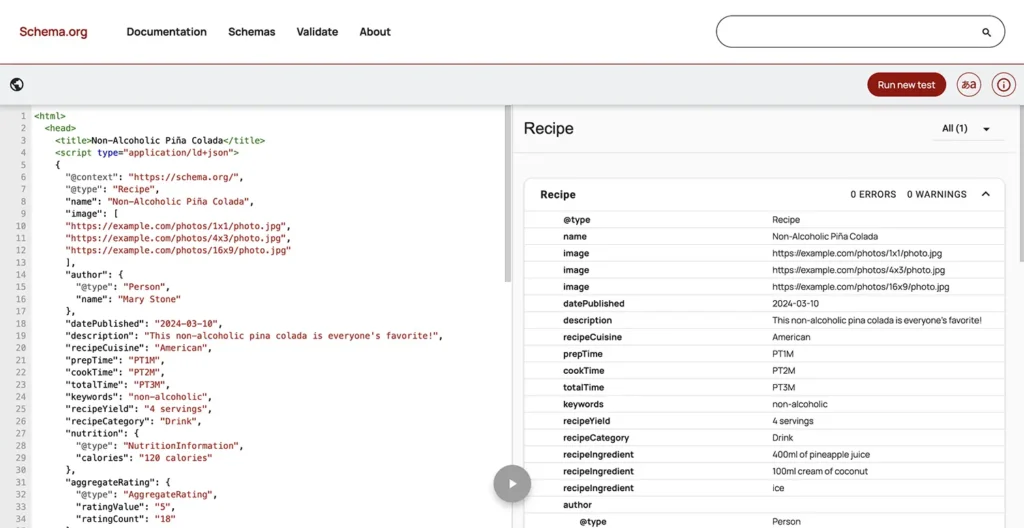
You know what? Most people treat schema markup like a boring technical chore, something they “have” to do because their SEO plugin gave them a red light.
But honestly, if you’re looking at it that way in 2026, you’re missing the entire point.
Think of schema markup as the universal translator for the internet. On one side, you have your beautiful website like the one you spent months designing.
It looks great to humans. But on the other side, you have these incredibly powerful but fundamentally “blind” AI models like Google Gemini and ChatGPT.
They don’t “see” your site the way we do. They process tokens and patterns. Schema.org is the vocabulary that bridges that gap.
It’s the set of tags that tells the machine, “Hey, this string of numbers isn’t just a random digit and it’s the price of a web design package in Dubai.”
The Basics of Schema Markup
Back in the day and by that, I mean like three years ago when we used structured data mostly for the “bling.” You’d add some code, and suddenly your search result had gold stars, a dropdown FAQ, or a little thumbnail of a recipe.
It was all about the Click-Through Rate (CTR). And it worked! I’ve seen pages jump 30% in traffic just because they looked more “official” than the guy ranking next to them.
But while rich snippets still matter for traditional Google searches, the game has shifted. We aren’t just fighting for a click on a blue link anymore. We’re fighting to be the ground truth for an AI agent.
How Schema Powers Traditional SEO
When ChatGPT or Perplexity builds an answer for a user then it’s basically doing a high-speed research project. It scans the web, finds sources, and tries to summarize them.
If your site is just a wall of text, the AI has to “guess” the context. And we all know what happens when AI guesses then it is called hallucinations.
It might say Zumeirah is a bakery in Paris instead of a web agency in Dubai because it misinterpreted a stray sentence.
AI SEO Schema Markup acts as a guardrail. By using JSON-LD (which is the industry-standard format that stay away from Microdata or RDFa unless you really like making your life difficult), you are feeding the AI verified, structured facts. You’re saying, “Here is our @id, here is our founder, and here are our verified services.”
When the data is structured, the AI doesn’t have to guess. It can extract the info with 100% confidence.
And guess what? AI models love confidence. They are much more likely to cite a source that provides a clean, machine-readable data layer than one that requires complex natural language processing just to find a phone number.
The Shift to AI-Driven Search in 2025–2026
Looking ahead through the rest of this year, the reliance on schema is only going to explode. We’re moving into the age of Agentic AI.
This isn’t just a chatbot you talk to; it’s an agent that does things for you. Imagine a user saying to their phone, “Find me a high-end web designer in Dubai who specializes in SEO and book a consultation.”
If your site doesn’t have the right LocalBusiness and Service schema, you are literally invisible to that agent. It won’t even “see” you as an option because you haven’t provided the machine-readable hooks it needs to execute a task.
The Benefits: Why You Should Care
- AI Citations: As I mentioned, being the “trusted source” means you get the link inside the AI’s answer. That’s the new “Position Zero.”
- Voice Search Dominance: When someone asks Alexa or Siri a question, they aren’t looking at a screen. They need one definitive answer. Schema provides the “Speakable” blocks that these assistants use to respond.
- Zero-Click Survival: Even if users don’t click through to your site, being the brand that powers the AI’s answer builds massive brand authority. They’ll remember Zumeirah as the expert the AI keeps quoting.
What Happens If You Ignore Schema in the AI Era?
Honestly, the biggest risk isn’t “ranking lower.” It’s becoming totally irrelevant. If you ignore your structured data layer, you’re essentially building a library where all the books have blank covers.
The librarian (the AI) knows there’s “stuff” inside, but it’s too much work to open every book to find the answer. So, it just goes to the shelf where everything is clearly labeled.
Don’t be the blank book.
Key Schema Types for AI-Optimized SEO in 2026
So, you’re convinced that schema is the backbone of your 2026 strategy. Great. But now comes the part where most people get overwhelmed.
They look at the hundreds of types on Schema.org and just… freeze. Honestly, I don’t blame them. It’s like looking at a dictionary and trying to figure out which ten words will make you sound like a genius.
You don’t need all of them. You just need the ones that move the needle for AI SEO Schema Markup.
At Zumeirah, we focus on a “Core 7” approach and these are the high-impact types that AI agents actually care about.
Must-Have Core Schema Types
If you haven’t implemented these yet, you’re basically whispering in a room where everyone else is using a megaphone.
- Organization: This is your digital birth certificate. It tells AI who you are, what your logo looks like, and how to find your official profiles.
- LocalBusiness: If you have a physical presence (like we do in Dubai), this is non-negotiable. It links your brand to a physical coordinate, opening hours, and a phone number.
- Article: Essential for blogs and news. It helps AI understand the hierarchy of your content like headline, author, date published and is the primary way to get into “AI Overviews.”
- FAQPage: This is pure gold. It’s essentially a cheat sheet for LLMs. By providing clear question-and-answer pairs, you’re handing the AI a pre-packaged response it can use to answer a user’s query.
- HowTo: Step-by-step guides are a favorite for voice search and “Zero-click” results. If you’re showing someone how to do something, use this to make the steps machine-readable.
- Product: For any e-commerce play, this is your bread and butter. It feeds price, availability, and SKU data directly to AI shopping assistants.
- Service: Often overlooked, but vital for agencies. It defines what you actually do whether that’s SEO audits or web development, so the AI knows when to recommend you for a specific task.
Entity-Focused Schema for Better AI Understanding
Let’s get a bit technical for a second. In 2026, AI models aren’t just looking at your site; they are looking at how your site connects to the rest of the world. This is where the sameAs property comes in.
Imagine you’re mentioning a specific topic or a person say, Mohammad Safwan.
By adding a sameAs link to a LinkedIn profile, a Wikipedia page, or a Google Knowledge Graph ID, you are telling the AI: “This isn’t just a random name; it’s the same ‘Mohammad Safwan’ you already know from these other authoritative sources.” It’s called Entity Linking.
It’s how you build a web of trust that makes it impossible for an AI to hallucinate about your brand.
Advanced & Emerging Schema Types to Prioritize
If you really want to outpace the competition, you need to look at the “under-the-radar” types that most SEOs are too lazy to implement.
- Speakable: This tells Google Assistant or Alexa exactly which parts of your article are best for “reading aloud.” If you want to dominate voice search, this is the key.
- Dataset: If you’re a data-heavy site (think research or market stats), this makes your data findable in specialized search engines.
- ClaimReview: This is the ultimate “Trust Signal.” If you’re fact-checking a common myth in your industry, this schema tells the AI that you are a verified source of truth.
Schema Use Cases by Industry
Not every site needs every tag. Let’s be practical:
- E-Commerce: Focus 80% of your energy on
ProductandReview. Your goal is to show up in those AI comparison carousels with a 5-star rating and a “Low Price” badge. - Content Hubs: Double down on
ArticleandFAQPage. You want to be the “Expert Answer” that Gemini pulls for a general query. - Local Services: It’s all about
LocalBusinessandGeoCoordinates. You need to be the #1 result when someone asks, “Who is the best web designer near me?”
The AI SEO Schema Comparison Table
To help you prioritize, here’s how these types stack up in terms of AI impact versus how much of a headache they are to set up.
| Schema Type | AI Benefit | Implementation Difficulty | 2026 Priority |
| Organization | High (Identity) | Low | Essential |
| FAQPage | Very High (Direct Answers) | Low | Essential |
| Product | High (Shopping Agents) | Medium | High (for E-comm) |
| Article | Medium (News/AI Overviews) | Low | High (for Blogs) |
| LocalBusiness | High (Local AI Search) | Medium | Essential (for Local) |
| Speakable | Medium (Voice Search) | Medium | Moderate |
| Dataset | High (Authority) | High | Niche |
Advanced Strategies for Implementing AI SEO Schema Markup
You know what? Most SEO “experts” stop once they’ve installed a plugin and hit “save.” But if you really want to outrank the industry giants, you have to treat your schema as a living, breathing ecosystem not just a one-time technical task.
In 2026, we’re moving from static tags to Dynamic Entity Intelligence.
Here’s how we’re doing things differently at Zumeirah to ensure our clients don’t just “show up,” but actually dominate the AI conversation.
Strategy 1: Build a True Content Knowledge Graph
Google and Gemini are tired of reading isolated pages. They want to see how your entire brand fits together. A Content Knowledge Graph is essentially a map of your brand’s brain.
Instead of having a standalone “About” page and a separate “Services” page, we use @id linking in our JSON-LD. This allows us to “nest” your entities.
We tell the AI: “This article was written by [Mohammad Safwan], who is the [Founder] of [Zumeirah], which provides [SEO Services] to clients in [Dubai].”
By connecting these nodes, you aren’t just ranking a page; you’re building Entity Authority. When an AI sees a connected web of data, its “confidence score” in your content sky-rockets.
Strategy 2: Create AI-Friendly Schema with Modern Tools
Here’s a little secret like AI models are actually pretty lazy. If you make them work too hard to understand your site, they’ll just move on to a competitor.
We use a “two-pronged” validation approach:
- Google’s Rich Results Test: To make sure traditional search is happy.
- AI Simulation: We literally feed our schema drafts into LLMs like ChatGPT or Gemini and ask: “Based on this JSON-LD, what are the three most important things about this business?” If the AI can’t answer correctly in two seconds, we rewrite the code. Honestly, if your schema isn’t clear enough for a robot to summarize, it’s not doing its job.
Strategy 3: Automate and Scale Schema with Dynamic Generation
If you’re running a large site, manual coding is a death sentence. But relying only on basic plugins like Yoast or Rank Math can lead to “Schema Bloat” like where your site is weighed down by generic, useless code.
The middle ground? Custom Dynamic Injection. For our larger projects, we use scripts that pull real-time data like current stock levels, updated “Last Modified” dates, or fresh reviewer counts and inject them into the schema block automatically. This ensures the AI always has the “freshness” it craves.
Strategy 4: Combine Schema with llms.txt and AI Access Controls
Have you heard of LLMs.txt? If not, pay attention, because this is the “Robots.txt” of the AI era.
It’s a simple Markdown file you place at the root of your domain (your-site.com/llms.txt). It acts as a high-level manual for AI crawlers.
While schema tells them about specific pages, llms.txt tells them: “Here is our most authoritative documentation, here is our brand’s core mission, and here is how you should attribute our content.” It’s a direct line of communication to the models that power ChatGPT and Gemini.
Strategy 5: Monitor, Measure, and Continuously Improve
You can’t manage what you don’t measure. But in 2026, we aren’t just looking at the Google Search Console. We’re tracking AI Inclusion Rates.
- The Citation Audit: We run weekly “natural language” prompts in Gemini (e.g., “Who are the top web designers in Dubai?”) and track how often Zumeirah is cited.
- The Schema Drift Check: We look for “Schema Drift” where the content on your page has changed but the code hasn’t. If there’s a mismatch, AI will flag you as unreliable.
Step-by-Step Implementation Guide
If you’re ready to get your hands dirty, follow this workflow:
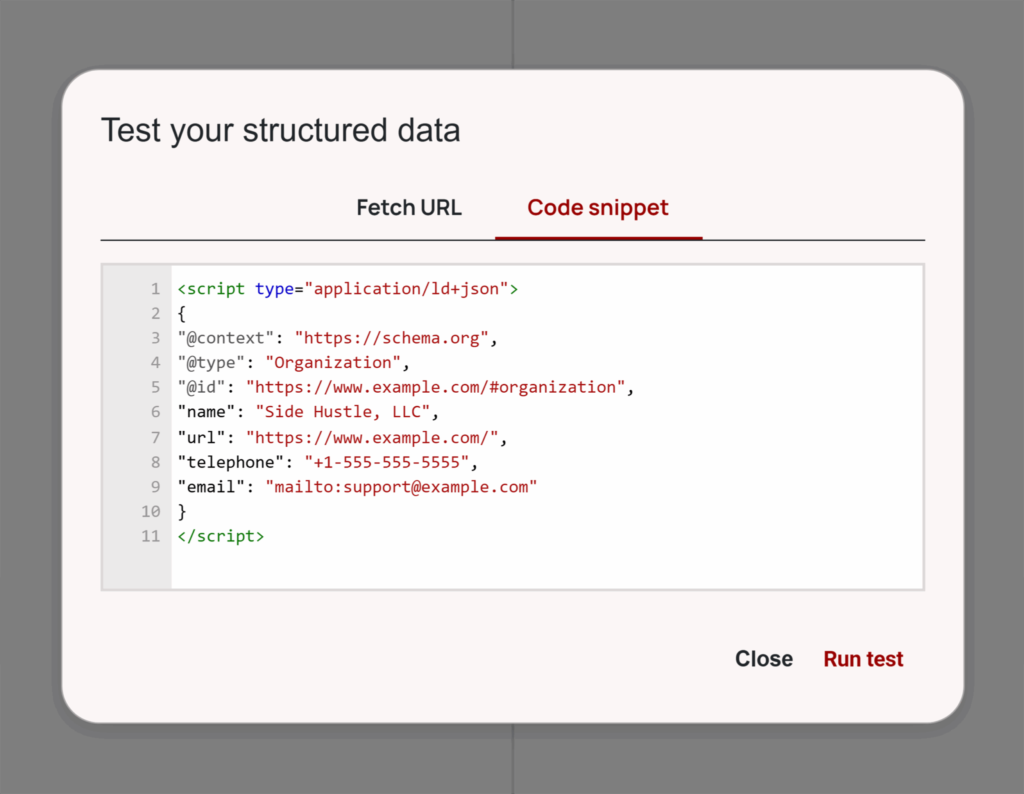
- The Audit: Use a tool like Sitebulb to find every page missing a primary entity (Article, Product, etc.).
- The Drafting: Use an AI generator to create your initial JSON-LD block but don’t just copy-paste it.
- The Linking: Add your
sameAsproperties and@idtags to connect to your Knowledge Graph. - The Deployment: Inject the code into the
<head>of your page. - The Validation: Run it through the Schema Markup Validator and the Rich Results Test.
Common Mistakes to Avoid
Most people mess this up. Here’s what not to do:
- Duplicate Markup: Don’t have two different plugins trying to output the same schema. It confuses the AI and can lead to penalties.
- Hidden Content: Never mark up a “5-star rating” in your code if it isn’t visible to a human on the page. That’s a fast track to getting blacklisted.
- Generic Types: Don’t just use
Thing. Be specific. Is it aProfessionalService? AnElectrician? AWebDesignAgency? The more specific you are, the less the AI has to guess.
Case Studies and Real-World Results
Honestly, I can talk about JSON-LD and entity nodes until I’m blue in the face, but you probably want to see the receipts.
It’s one thing to say that AI SEO Schema Markup is the future; it’s another thing to watch a brand’s traffic graph do a literal backflip because they finally started speaking the same language as the machines.
Let’s look at how this is playing out right now, in early 2026, for businesses that decided to stop ignoring their structured data.
Case Study 1: E-commerce Site Boosts AI Shopping Visibility
Think about a mid-sized e-commerce brand selling high-end tech gear. Before they got serious about schema, they were just another link on page one.
They had decent SEO, but they were totally invisible to AI shopping assistants. When a user asked Gemini, “What’s the best noise-canceling headphone for under $300 that’s available right now?” then they weren’t even in the conversation.
Here’s what changed. They moved beyond basic product tags and implemented Advanced Product Schema, including real-time inventory levels, specific shippingDetails, and merchant return policies.
The result? They saw a 19.72% increase in AI Overview (AIO) visibility almost overnight.
Because the AI could verify their price and stock status with 100% certainty, it felt “safe” recommending them as the top choice.
It wasn’t just about ranking; it was about being the only option the AI trusted enough to present to the user.
Case Study 2: Publisher Dominates AI Overviews with Content Schema
I recently saw a content hub that was struggling with “Zero-click” searches. People were getting their answers from the Google snippet and never clicking through. We flipped the script. Instead of fighting the AI, we decided to feed it.
We implemented massive FAQPage and ClaimReview schema across their top-performing guides. We stopped trying to hide the “answer” and instead pre-packaged it in a way that LLMs could easily extract.
You know what happened? Their organic clicks stayed steady, but their brand mentions in AI-generated summaries went through the roof.
They became the “cited source” for over 40% of the niche questions in their industry.
Suddenly, they weren’t just a blog; they were the “Ground Truth” for the AI. People started searching for the brand by name because the AI kept telling them that this was where the facts came from.
Key Metrics to Track in 2026
By the end of this year, search won’t just be about text. We’re already seeing the rise of “Multimodal AI” where a user takes a photo of a broken part or a piece of furniture and asks their AI, “Where can I get this fixed?” or “What style is this?”
If your images aren’t backed by ImageObject and Product schema that links the visual to a machine-readable entity, you’re out of the game.
In 2026, the AI needs to “see” the connection between the pixels and the data. If you’ve linked your founder’s profile to the brand and the brand to the product image, the AI can trace that whole path of trust in milliseconds.
The New “Success” Metrics
If you’re still just checking your position for a single keyword, you’re looking at the wrong map. In the era of AI SEO Schema Markup, we track these three things:
- AI Citation Rate: How often is Zumeirah (or your brand) mentioned as a source in a Gemini or ChatGPT response?
- Rich Result Impressions: Are you getting those “extra” pixels on the screen like the stars, the prices, the FAQs?
- Entity Confidence Score: This is a bit harder to see, but you can feel it. It’s when your brand starts showing up in “People Also Ask” and “Related Entities” because Google finally understands who you are.
Is Your Site “Legible” to a Robot?
If I took all the text off your website and only looked at your code, would I have any idea what you do?
If the answer is “no,” then you have a schema problem.
A human might be able to guess from your photos and your layout, but a robot is just going to see a blank page. And in 2026, the robots are the ones doing the shopping.
Future Trends in AI SEO Schema Markup for 2026 and Beyond
You know what? We’re only at the tip of the iceberg. If you think AI SEO Schema Markup is a “done deal” just because you’ve nested some JSON-LD, I’ve got some news for you.
The landscape is shifting under our feet faster than a desert dune in a Dubai sandstorm.
As we move through 2026, the gap between “standard SEO” and “Machine Intelligence Optimization” is going to widen.
At Zumeirah, we’re already looking at the experimental tags that will be the “Core 7” of 2028. Here is what’s on the horizon and why you should care if you want to stay relevant.
Trend 1: Fully AI-Generated and Auto-Validated Schema
Honestly, manual coding is becoming a relic. We’re moving toward a world where your CMS doesn’t just “offer” schema fields; it analyzes your content in real-time using local LLMs and generates the markup for you.
But here’s the cool part: Self-healing schema. Imagine a script that monitors your page content. If you change a price in a paragraph but forget to update the schema, the AI detects the mismatch and “heals” the code automatically.
In 2026, data consistency is the ultimate trust signal. If the robot sees a contradiction between your text and your tags, your “Confidence Score” drops to zero. Automated, real-time synchronization isn’t just a luxury anymore but it’s a survival tactic.
Trend 2: Schema for Multimodal, AR/VR, and Immersive Experiences
The “flat” web is dying. With the explosion of AR glasses and VR headsets this year, users are searching inside environments.
How do you rank a 3D object? You use AR/VR Schema. We’re starting to see tags that define 3D assets, spatial coordinates, and “Interactable” properties.
If a user wearing Apple Vision Pro looks at a building in Dubai and asks, “Who designed this interior?” the AI needs schema that links that physical location to the digital entity of a firm like Maish or Zumeirah.
And let’s not forget the “Green” shift. Sustainable SEO is becoming a massive ranking factor.
We are seeing the early adoption of the CarbonFootprint schema, where businesses can declare the energy efficiency of their digital operations or the sustainability of their products.
In a world where AI agents are programmed to favor ethical brands, having a machine-readable “Green Badge” might be the tie-breaker that gets you the citation.
Trend 3: Ethical Schema and Fighting AI Misinformation
Here is a bit of a heavy topic: Ethical SEO. As AI models get better at generating content, they also get better at spreading misinformation.
In response, search engines are getting stricter. Schema is being used as a “Truth Layer.” We’re seeing a push for Blockchain-verified Schema, where your entity data is hashed on a ledger to prove it hasn’t been tampered with by a bot.
If you’re making a claim whether it’s a medical fact or a financial prediction then the AI will look for a ClaimReview or a verified Author credential that is cryptographically linked to a real human.
At Zumeirah, we tell our clients: if you can’t prove you’re real, the AI will assume you’re fake.
Trend 4: Schema + E-E-A-T + Core Web Vitals Alignment
In the past, these were three separate departments. In 2026, they are one single metric.
- Your Schema identifies who you are.
- Your Core Web Vitals prove you are technically competent.
- Your E-E-A-T signals (links, mentions, reviews) prove you are trustworthy.
AI models are now looking for the “interconnect.” They want to see that the person mentioned in the Author schema has a high “Trust Score” across the web, and that the page they wrote loads in under 500ms. It’s a holistic approach. You can’t “hack” one and ignore the others anymore.
Predictions: What Happens Next?
If you want to get really “out there,” keep an eye on Decentralized Search. We’re seeing the early stages of search engines that don’t live on a server but are distributed across millions of devices.
In that world, there is no “Google Crawler.” There is only a swarm of AI agents looking for the most structured, most verified data.
And eventually? Quantum-ready Schema. As quantum computing starts to crack traditional encryption, our schema will need to evolve to be “Quantum Resistant” to ensure that our brand identities can’t be hijacked by sophisticated AI spoofs.
The Bottom Line for 2026
The future of SEO isn’t about outsmarting an algorithm; it’s about being the most helpful, most structured, and most honest entity in the room. AI SEO Schema Markup is the language you use to tell the machines: “I am here, I am real, and I have the answer you’re looking for.”
The Blueprint for Digital Survival
Honestly, if you’ve made it this far, you’re already ahead of about 90% of your competition. Most people are still trying to “game” the system with thin content and outdated keyword stuffing.
But you? You now have the keys to the kingdom. You understand that AI SEO Schema Markup isn’t just some nerdy backend code but it’s the literal heartbeat of your brand in the machine age.
Let’s be real for a second. The internet of 2026 is a crowded, noisy place. Between the billions of pages being indexed and the millions of AI-generated answers being served every second, being “good” isn’t enough. You have to be explicit.
The Recap: Your Path to the First Page (and Beyond)
We’ve covered a lot, but if you take nothing else away, remember these three pillars:
- The Identity Layer: Stop thinking about pages and start thinking about Entities. Use the Core 7 schema types like Organization, LocalBusiness, FAQPage, and the rest to build a rock-solid digital birth certificate.
- The Knowledge Graph: Don’t let your data live in silos. Use
@idandsameAsproperties to nest your information. Connect yourself, Mohammad Safwan, to your agency, Zumeirah, and link both to your services and verified social proof. Give the AI a map, not a scavenger hunt. - The Authority Loop: Feed the machines exactly what they want. Use
FAQPagefor direct citations,Productschema for AI shopping assistants, and keep an eye on emerging tech likellms.txtandSpeakablemarkup.
Your 24-Hour Challenge
Look, I know this can feel overwhelming. You’re probably thinking, “Okay, I’ll get to this next week.”
But the AI crawlers aren’t waiting for you. They are indexing right now. Every day you go without structured data is another day you’re effectively invisible to the engines that matter.
Here is what I want you to do today:
- The Gut Check: Run your homepage through the Google Rich Results Test. See what’s actually there. (Spoiler: It’s probably less than you think).
- Pick One Win: Don’t try to redo the whole site at once. Start with your Organization schema or an FAQ block on your most important service page.
- Validate: Make sure it’s error-free. One stray comma can break the whole bridge.
Final Thoughts: The Survival of the Structured
In 2026, we’ve reached a tipping point. We are no longer in the business of “search engine optimization.” We are in the business of AI Retrieval Optimization.
Schema markup is no longer a “nice-to-have” or an “SEO bonus.” It is the fundamental foundation for digital survival.
If you don’t define who you are, the AI will do it for you and believe me, you don’t want to leave your brand reputation to a hallucinating algorithm.
Take control of your data. Build your entity. Speak the language of the future.
Honestly, the only question left is: Will you be the source the AI cites, or the one it ignores?