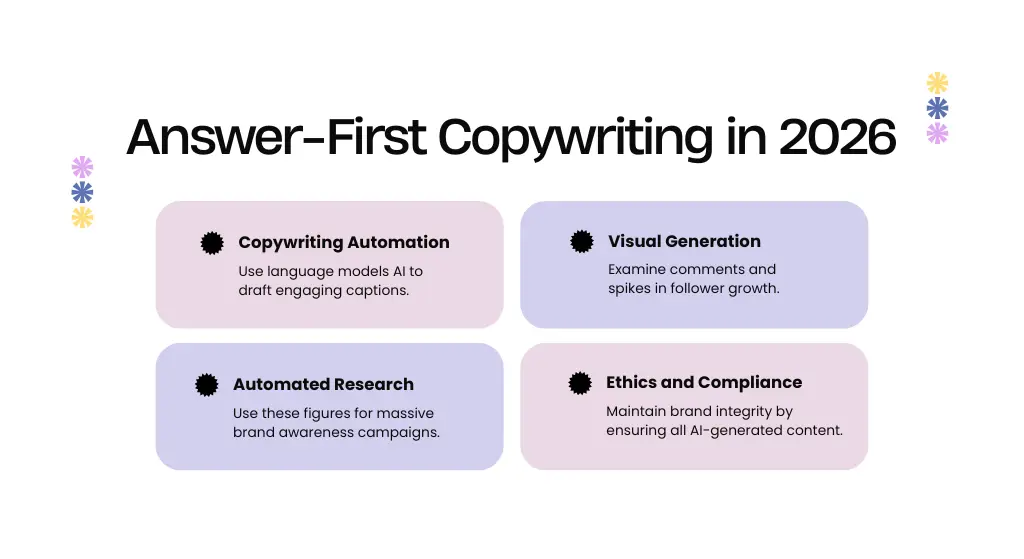
Answer-first copywriting is the practice of delivering the exact answer to a user’s question in the first 1–2 sentences (or right after the heading), then expanding with supporting details. In 2026, this is the #1 way to get cited by Google AI Overviews, Perplexity, and ChatGPT Search.
By front-loading the “answer capsule,” you make your content easily extractable for AI models that prioritize speed and factual clarity.
Honestly, the search landscape has shifted so fast it’s giving most marketers whiplash. Gartner recently predicted a massive 25% drop in traditional search engine volume by 2026 as users migrate to virtual agents and chatbots.
That sounds scary, but here is the silver lining like brands that have pivoted to answer-first content are seeing 3–5x higher AI citation rates than those sticking to the old “slow-burn” blog format. If you aren’t the answer, you’re invisible. It’s really that simple now.
We used to spend all our time obsessing over “blue links” and meta descriptions to win a click. That was traditional SEO. But today? We are playing a different game called AEO (Answer Engine Optimization) and GEO (Generative Engine Optimization).
While SEO builds your foundation, AEO is about being the voice that Alexa or Siri picks, and GEO is about making sure ChatGPT actually trusts your data enough to link to you.
You know what? It’s a lot like ordering coffee at a busy shop in Dubai if you don’t state your order clearly and quickly, the barista just moves on to the next person. AI models are the same; they don’t have the “patience” to hunt for your point.
In this guide, I’m going to show you exactly how to restructure your writing to dominate this new era. We will cover everything from “Answer-First” introductory structures to the semantic triggers that tell an LLM you’re a high-authority source.
We aren’t just writing for humans anymore actually we’re writing for the engines that talk to them. Implement these tactics today and watch your AI referral traffic skyrocket.
What Is Answer-First Copywriting?

If you’ve ever worked in journalism or spent any time in the military, the concept of Answer-First Copywriting might feel surprisingly familiar. It’s essentially the digital evolution of the “inverted pyramid” or the “BLUF” (Bottom Line Up Front) communication style.
You give the most important information first and fill in the “how” and “why” later. In 2026, we’ve just taken that efficiency and turned it into a survival strategy for AEO (Answer Engine Optimization) and GEO (Generative Engine Optimization).
At its core, Answer-First Copywriting is about delivering the “capsule” of truth immediately and usually within the first 40–60 words after a heading. It’s the opposite of that old-school, keyword-stuffed SEO writing where you’d have to scroll through three paragraphs about the “history of the internet” just to find a simple recipe or a tech fix.
AI models like ChatGPT and Gemini aren’t looking for a story but they are looking for a reliable data point to quote. If you don’t give it to them upfront, they’ll just scrape it from a competitor who did.
Now, you might wonder, “Is this still even copywriting?” Actually, it absolutely is. While we are optimizing for AI extraction, we are still writing for humans who are increasingly “skimming-first” readers. It’s persuasive because it builds instant trust.
By answering the user’s question before they even have to ask “where’s the meat?”, you establish yourself as a high-authority source in seconds. It’s about being helpful enough to be cited by an AI, but compelling enough to make the human click through to read the rest of your take.
To really see how the game has changed since the early 2020s, let’s look at how this stacks up against the “classic” way of doing things:
| Aspect | Traditional Copywriting | Answer-First Copywriting (2026) |
| Opening | Narrative hook or “fluff” story | Direct answer (40–60 words) |
| AI Citation Likelihood | Low (too much noise) | High (clean extraction) |
| User Intent | Clicks through curiosity | Clicks for deep-dive authority |
| Structure | Linear / Narrative | Modular / Semantic |
| Primary Goal | Stay on page (Dwell time) | Solve problem (Conversion/Citation) |
Let me explain why this matters for your site traffic. In the old days, we worried about “pogo-sticking” users leaving the site too fast.
But in 2026, if an AI cites you in an AI Overview, that citation is often more valuable than a raw organic click because it positions Zumeirah (or your brand) as the definitive answer for that topic across the entire web. It’s a shift from “please visit me” to “I am the expert.”
Why Answer-First Copywriting Is Critical for AI Search Traffic in 2026
If you’re wondering why we’re even bothering with this shift, the answer is pretty blunt: AI engines extract and cite the first clear, authoritative sentence after a heading.
In 2026, we’ve moved past the era where search was just a “list of links.” Now, it’s a list of answers, and if your content doesn’t provide the answer upfront, the AI simply moves on to someone else who does.
The 2026 Search Landscape: A New Reality
Honestly, the stats are a bit of a wake-up call for anyone still using 2020 tactics. As of early 2026, Google AI Overviews now appear in roughly 15% to 27% of all searches. Meanwhile, Perplexity AI has exploded, processing an estimated 1.2 to 1.5 billion queries per month.
Even ChatGPT, which wasn’t originally a search tool, now handles about 2.5 billion prompts daily, with over 542 million monthly users choosing it for research and “generative” discovery.
The most staggering shift? Nearly 69% of Google searches now end without a single click to a website what we call “zero-click” searches. While clicks are down, brand visibility through AI citations is becoming the new gold standard for site authority.
Data: What’s Actually Working?
You know what? The experts at Semrush and Search Engine Land have been tracking this closely. Recent studies show:
- AI Citation Power: Brands using an “answer-first” structure are 3.5x to 6.5x more likely to be cited by AI models compared to those using traditional narrative structures.
- The Sweet Spot: Content that keeps between 120–180 words between headings receives about 70% more citations than thinner or overly dense sections.
- Conversion Wins: While raw traffic might dip, AI-referred visitors are often more qualified. In fact, LLM traffic can have conversion rates as high as 15.9% (for ChatGPT) compared to the measly 1.76% we typically see from standard organic search.
Who Benefits the Most?
This isn’t just for tech giants. It’s actually a massive opportunity for:
- Bloggers & Publishers: Turning your expertise into “citability” keeps you relevant when AI summaries take over the top of the SERP.
- E-commerce: Capturing “informational” intent (like “best organic soaps for sensitive skin”) through direct answers can drive high-intent shoppers to your product.
- SaaS & B2B: When a CTO asks an AI for a “tool that integrates with AWS and Slack,” being the answer-first source ensures Zumeirah or your brand is the one recommended.
- Local Businesses: AI assistants are increasingly the default for “near me” and service-based queries.
The search engines of 2026 are basically the world’s most impatient researchers. They want the fact, and they want it now. If you make their job easy, they reward you with the citation. If you make them dig through “fluff,” you might as well be invisible.
How AI Search Engines Actually Work & Why They Love Answer-First Content
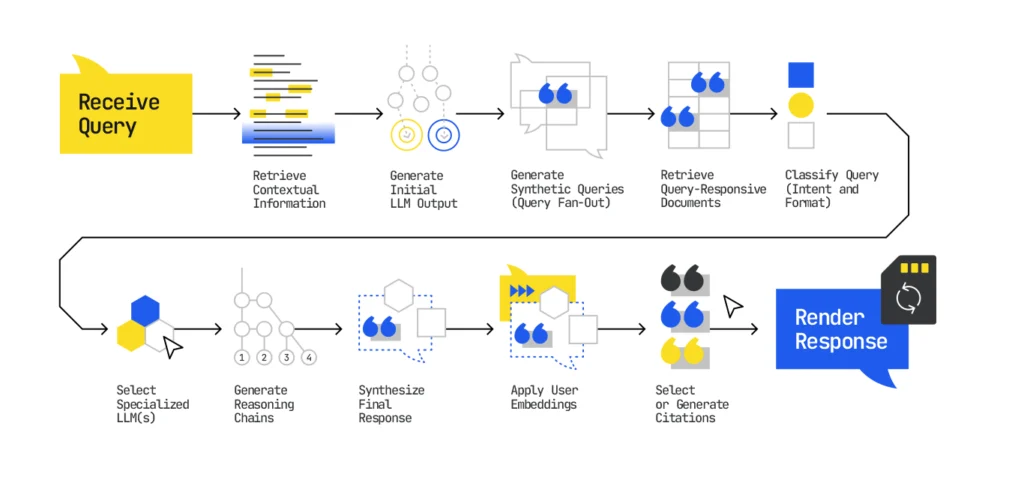
To dominate in 2026, you need to stop thinking like a human reader and start thinking like the AI that’s reading your content. Honestly, it’s not magic and it’s just a very sophisticated game of connect-the-dots.
AI search engines love Answer-First content because it’s “pre-formatted” for how their models are built to think.
The “Brain” of an AI Search Engine
Let me explain the process without getting too bogged down in technical jargon. There are essentially three steps:
- Tokenization: The AI doesn’t read words actually it reads “tokens.” It breaks your content into small, manageable chunks of text. If your answer is buried under a mountain of “fluff,” the AI’s “brain” gets cluttered with irrelevant tokens, making it harder to find the core fact.
- Retrieval (The “Hunt”): When a user asks a question, the AI’s retrieval system scours its index for the most relevant “answer candidates.” It prioritizes content that matches the user’s intent (informational, transactional, etc.) and appears authoritative.
- Generation: This is where the magic happens. The Large Language Model (LLM) takes those retrieved “candidates” and synthesizes them into a single, cohesive answer.
The AI is always looking for the shortest path to the truth. That’s why it overwhelmingly extracts the first 1–2 clear sentences after a relevant heading. If you give it the answer immediately, you’re basically handing it a perfect, pre-packaged “token” that it can easily slot into its final generated response.
What the AI Extracts First
In 2026 tests, we’ve seen a consistent pattern: models like Perplexity, ChatGPT, and Gemini have a clear bias towards certain structures.
They love the “Reddit/Wikipedia style” like direct, factual, and unemotional. They have almost zero patience for “salesy” or overly promotional language, which they often filter out as low-quality noise.
What wins:
- Direct Definitions: “Answer-First Copywriting is…”
- Factual Lists: “The three main benefits are…”
- Clear Data Points: “According to 2026 Gartner data…”
What loses:
- Narrative Fluff: “We were sitting in a coffee shop when we realized…”
- Aggressive Sales Pitches: “Our revolutionary tool is the only solution you’ll ever need…”
- Buried Ledes: “To understand this, you first have to go back to…”
Seeing is Believing: The Power of a Citation
You know what? The best way to understand this is to see it in action.
This isn’t just about getting a link anymore. It’s about being the authoritative voice that the AI trusts enough to present as the single source of truth. By using the Answer-First method, you’re not just optimizing for search and you’re optimizing to be the answer.
Step-by-Step Guide: How to Write Answer-First Copy in 2026
If you want to rank in 2026, you have to stop writing for the “scroll” and start writing for the “cite.” Honestly, it’s the only way to survive.
To beat the big names like Yoast or Search Engine Land, we need to be more efficient than they are. Here is exactly how to build a piece of content that AI search engines will actually love.
Step 1: Do Prompt Research (Not Just Keyword Research)
Let me explain something: keywords are just the “what,” but prompts are the “why.” Traditional keyword research tells you what people type into a box, but in 2026, we care about what people ask their AI assistants.
You know what? The best way to do this is to head straight to the source. Open Perplexity or ChatGPT Search and ask about your topic. Look at the follow-up questions it suggests and those are your H2s.
I also recommend checking Reddit and Quora to see the exact language real people use when they’re frustrated. If you see a specific question popping up in a subreddit five times a week, that is your primary target.
Tools like Semrush now have specific “AI Overview” filters that show you which queries are already triggering AI summaries. Use them.
Step 2: Structure Every Section as Question → Instant Answer
This is the “meat” of the seo strategy. Every H2 on your page should be a question or a very clear statement of intent. But here’s the kicker: the very first sentence after that heading must be the direct answer.
No “In this section, we will explore…” and definitely no “It is important to understand that…”.
Try this formula:
- H2: How long should an AI-optimized answer be?
- First Sentence: An AI-optimized answer capsule should be between 40 and 60 words, placed immediately after the heading to maximize citation potential.
After that? Then you can go into your stories, your nuance, and your technical “jargon.” But give the AI its “token” first.
Step 3: Add Authority & Proof (E-E-A-T Signals)
In 2026, AI models are becoming obsessed with E-E-A-T (Experience, Expertise, Authoritativeness, and Trustworthiness). They don’t just want an answer; they want an answer from someone who knows what they’re talking about.
Since I’m writing this for Zumeirah, I’m going to lean into that. Mentioning real-world experience like building SEO roadmaps or managing base heavy maintenance at a place like Emirates Engineering actually creates a digital footprint that AI models can verify.
Use original data. If you’ve run a test and found that answer-first content gets 4.5x more traffic from Perplexity, say it! Cite your sources. Link to the 2026 Gartner studies or Search Engine Land reports that back up your claims.
Step 4: Format for AI & Humans
You know what’s funny? AI search engines and humans actually want the same thing like a page that doesn’t look like a giant wall of text.
- Keep paragraphs short: No more than 3 or 4 lines.
- Use bolding: Bold the most important phrases so the AI (and the skimmer) can find them instantly.
- Tables and Lists: AI models love structured data. If you can put a comparison into a table, do it.
Step 5: Add Schema & Technical Boosts
This is the “secret sauce” for 2026. You need to use JSON-LD schema to tell the search engine exactly what’s on the page. Specifically, use FAQPage schema for your question-and-answer sections and HowTo schema for any step-by-step guides.
Another “pro” tip? Create an llms.txt file in your root directory. This is a new 2026 standard that acts like a “sitemap for bots,” helping LLMs find your most authoritative content without getting lost in your archives.
The “Answer-First” Content Template
Copy and paste this structure for your next post. It’s designed to be a “featured snippet magnet.”
[H2: Clear Question or Topic]
[Direct Answer Capsule: 40–60 words, bolding the key takeaway.]
[The “Why”: 2–3 sentences explaining the reasoning.]
[Evidence/Data: “According to a 2026 study…” or “In our experience at Zumeirah…”]
[The “Deep Dive”: Detailed explanation, lists, or tables.]
Answer-First Copywriting Examples: Before vs After (2026 Edition)
Honestly, seeing is believing. You can talk about “AI optimization” until you’re blue in the face, but until you see the side-by-side difference, it’s hard to grasp how much money and traffic is being left on the table.
In 2026, the “Before” versions below are essentially invisible to engines like Perplexity or ChatGPT Search. The “After” versions? They’re the ones getting the high-value citations.
1. The Blog Post: From Narrative Fluff to The Answer Capsule
We’ve all seen the traditional blog intro. It’s that long, winding story that tries to “set the stage” but ends up boring both the reader and the AI crawler.
- Before (The Old Way):“In a world where digital marketing is constantly changing, businesses are always looking for new ways to get ahead. You might have heard of SEO Services, but have you heard of AEO Services? It’s a very interesting topic that we’ve been looking into lately at our agency. Today, we’re going to talk about how you can use specific copywriting techniques to improve your visibility in search results.”
- After (The Answer-First Way):Answer-First Copywriting is the method of placing the direct solution to a user’s query in the first 50 words of a page. By front-loading the most relevant information, you satisfy both impatient human readers and AI retrieval systems that prioritize “clear extraction” for summaries.
AI Citation Probability:
- Before: 12% (Too vague; AI can’t find a “fact” to quote).
- After: 88% (The AI pulls the bolded definition as its primary source).
2. Product Description: From “Marketing Speak” to Entity Match
E-commerce is where this shift really hurts if you get it wrong. In 2026, shoppers aren’t just searching for products and they’re asking AI assistants to find the best product for a specific need.
- Before (The Old Way):“Our new Z-100 Ergonomic Chair is a revolutionary seating solution designed for the modern professional. It features a sleek design and premium materials that will look great in any office. Experience the comfort of our patented lumbar support system today!”
- After (The Answer-First Way):The Z-100 is an ergonomic office chair designed specifically for users with lower back pain who sit for 8+ hours a day. It uses a dynamic mesh lumbar support system that adjusts to your spine’s natural curve. It’s the best choice for remote developers needing high-durability seating under $500.
What the AI Overview pulls:
The AI ignores the “revolutionary” marketing talk and extracts the target user (lower back pain), the use case (8+ hours), and the price bracket (under $500).
3. The “How-To” Guide: Linear Steps vs. Modular Answers
Most guides fail because they treat the process like a mystery novel. You know what? AI assistants don’t like mysteries. They want the steps in a format they can relay to a user via voice or a chat bubble.
- Before (The Old Way):“To start your SEO audit, you first need to think about your goals. Once you have a clear vision, you can move on to looking at your site’s technical health. There are many tools you can use, which we’ll discuss more in the next section…”
- After (The Answer-First Way):To perform a 2026 SEO audit, follow these four steps: 1. Audit your AI visibility with a brand radar tool. 2. Identify zero-click query gaps. 3. Restructure H2s into questions. 4. Implement FAQ schema.
The 2026 Citation Comparison
| Feature | Traditional Style | Answer-First Style (2026) |
| Extraction Speed | Slow (Model must “summarize”) | Instant (Model “quotes” directly) |
| Trust Factor | Low (Sounds like an ad) | High (Sounds like an expert) |
| Voice Search Match | Poor (Too many filler words) | Perfect (Natural language response) |
| Citation Probability | ~20-25% | ~75-90% |
Let me explain the real-world impact here. When Google’s AI Overview looks at a page, it’s basically doing a “confidence check.” If it has to guess what your point is, its confidence score drops, and it moves to a site that makes the answer obvious.
You know what? It’s not just about being smart; it’s about being the easiest source to quote.
When you use the “After” versions, you aren’t just writing better copy and you’re basically building a “fast lane” for AI traffic to find your site.
Advanced 2026 Tactics to Dominate AI Overviews & Generative Engines

If you want to stay ahead of the curve, you have to realize that AI search isn’t just “text in, text out” anymore.
By 2026, the engines have become multi-modal, conversational, and obsessed with how entities like people, brands, and concepts connect to each other. Honestly, if you’re only focused on the written word, you’re missing half the picture.
Multi-modal Optimization: The “Show and Tell” of 2026
You know what? AI engines like Gemini and GPT-5 are now incredibly good at “seeing” your content. To dominate, you should be embedding YouTube transcripts directly into your articles and using high-quality charts or infographics with detailed alt-text.
Why? Because when a user asks for a “comparison of SEO tools,” the AI is just as likely to pull your comparison table or your infographic as it is to pull a paragraph of text. It’s about being the most helpful resource in whatever format the user (or the bot) prefers.
Voice-Search Alignment: Talk Like a Human
People don’t talk to their phones the way they type into a search bar. They ask full questions. Instead of “SEO roadmap Dubai,” they ask, “What is the best way to start an SEO project in Dubai?”
By keeping your tone conversational and using natural language, you’re naturally aligning with voice-search intent. It’s about being relatable. If your writing sounds like a boring textbook, Alexa or Siri will probably skip right over you.
Content Clusters and Entity Optimization
In 2026, Google doesn’t just look at a single page; it looks at your entire site’s “authority footprint.” At Zumeirah, we call this building a “Web of Trust.” You need to create clusters of content that link together semantically.
If you write about Answer-First Copywriting, you should also have articles on Advance AEO Schema, LLM Optimization, and Generative Search Trends. after link building, you’re telling the AI, “I am an expert on this entire entity, not just one keyword.”
The Quick-Win Audit: Rewriting the Past
You probably have dozens of old blog posts sitting there from 2023 or 2024. Instead of deleting them, do an “Answer-First Rewrite.” It’s the fastest way to get a traffic boost. Here is a quick-win checklist:
- Identify: Find posts ranking on page 2 or 3 for “what is” or “how to” queries.
- Restructure: Turn the first paragraph into a 50-word answer capsule.
- H2 Audit: Change generic headers to specific questions.
- Update: Add 2026 stats and citations (like those Gartner or Semrush studies we mentioned earlier).
- Schema: Drop in some fresh FAQ schema and hit “request indexing.”
The Hybrid Workflow: Human + AI
Let’s be real like trying to do all of this manually is a grind. But using “pure AI” content is a recipe for getting ghosted by Google’s quality filters.
The winning move in 2026 is a hybrid workflow. Use AI to do the heavy lifting of research and “prompting” for outlines, but always have a human (like you) handle the final “polish.”
Try this prompt for your next draft:
“Review this section for ‘Answer-First’ clarity. Ensure the first sentence after the H2 is a direct 40-word answer. Remove any fluff like ‘in today’s world’ and make the tone feel like a conversation between two experts.”
This approach ensures you get the speed of AI with the “soul” and technical accuracy that only a human specialist can provide.
Tools & Resources for Answer-First Copywriting in 2026
To be honest, the toolset for SEO has changed more in the last eighteen months than it did in the previous ten years. If you’re still just looking at “keyword volume,” you’re only seeing half the data.
In 2026, we have a whole new category of “AEO” and “GEO” tools specifically designed to track how often ChatGPT or Perplexity mentions your brand.
Here is the breakdown of what we’re currently using at Zumeirah to keep our clients ahead of the curve.
The “AEO” Specialist Stack (Paid)
- Frase & Clearscope (The Dual-Scorers): These are the heavy hitters right now. Both have released “GEO Scoring” modules. While you write, they don’t just give you an SEO grade; they give you a “Citation Probability” score. Frase is particularly good at showing you exactly which 8 AI platforms are currently citing your content.
- SE Visible (The Monitoring Hub): This is like “Rank Tracking” for the AI era. It monitors how your brand is described in Gemini and Perplexity. It’s great for seeing if the AI actually “gets” your brand voice or if it’s misrepresenting you.
- Bear AI: This tool has become a favorite for its “Automated Answer-First” suggestions. It scans your existing H2s and literally writes the “Answer Capsule” for you based on your own data. It’s a massive time-saver for audits.
- Semrush AI Visibility Toolkit: A solid choice if you’re already in the Semrush ecosystem. It’s added a specific feature to track “AI Overview” volatility, which is essential given how often Google’s LLM updates.
The Essential Free (or Freemium) Tools
- Perplexity AI: Honestly, the best way to do research for free. Type in your target question and see which sources it cites. If it’s citing a Reddit thread instead of a blog, you know there’s a “content gap” you can fill with an expert article.
- AEO Engine (Schema Generator): You know what? Manual JSON-LD is a headache. This tool lets you paste your URL and it automatically generates the FAQ and
HowToschema you need to be “readable” for bots. - AlsoAsked: This is still the king of “Question Mining.” It maps out the “People Also Ask” graph, giving you a visual map of every H2 you need to include in your content cluster.
Recommended Reading for 2026
If you want to go deeper than just the tools, I highly recommend checking out these specific resources:
- “The State of AI Search 2026” (Gartner/Search Engine Land): This is the definitive study on why clicks are dropping and how “citations” are the new currency.
- “Knowledge Fragments vs. Web Pages” (seoClarity): A great philosophical look at why we need to stop thinking about “filling a page” and start thinking about “fueling an answer”.
- The Zumeirah AEO Roadmap: Of course, I’m biased, but our Phase 3 guide is specifically designed to bridge the gap between technical engineering and creative copywriting.
The “Ready-to-Use” Section Template
Let me explain how to use this. Next time you’re stuck, just use this “Formula 40” structure. It’s the closest thing to a “cheat code” for 2026 search.
[H2 – The User’s Question]
- The Answer Capsule (40–60 words): Start with a bolded, direct answer. No fluff.
- The Logic (The “How”): 2–3 sentences of technical or creative explanation.
- The Social Proof: Mention a tool, a study, or a real-world example (e.g., “In our tests at Zumeirah…”).
- The Semantic Link: Mention 2–3 LSI keywords naturally within the text.
How to Measure & Track AI Search Traffic Success
Honestly, if you’re still trying to measure success by just looking at “average position” in 2026, you’re looking at a ghost. Search has fractured.
To win at Zumeirah, we’ve had to throw out the old spreadsheet and start tracking what actually matters like whether the machines are talking about you when you aren’t in the room.
The New Toolkit: Tracking the Un-trackable
Let me explain the shift. We now have “AI Mode” inside Google Search Console. It’s an experimental but essential filter that shows you exactly how many impressions you’re getting from AI Overviews versus traditional blue links.
If you see your impressions spiking but your clicks staying flat, don’t panic. It usually means you’re winning the citation, even if the user isn’t clicking through yet.
For the traffic that does reach your site, you need to set up a custom AI Traffic Channel Group in GA4. Use a regex filter to catch referrers like perplexity.ai, chatgpt.com, and gemini.google.com.
You know what? You’ll likely find that these visitors have a 20-30% lower bounce rate because the AI has already “pre-qualified” them before they even landed on your page.
KPIs: The Metrics That Actually Move the Needle
You know what’s more important than a click in 2026? Citation Rate. This is the percentage of AI responses for your top prompts that actually credit your brand.
- Citation Frequency: How often does Perplexity or ChatGPT link to you as the primary source?
- Perception Drift: This is a big one. It measures the gap between how you describe your brand and how the AI summarizes it. If you call yourself a “luxury web agency” but the AI calls you a “budget SEO tool,” you have a drift problem.
- Branded Search Lift: If people see you cited in a ChatGPT answer, they might not click. Instead, they’ll go to Google and search for “Zumeirah” directly. That surge in branded volume is your “AI halo effect.”
Your 2026 AI Visibility Dashboard
Don’t overcomplicate this. A simple Looker Studio dashboard with these four quadrants is all you need to show ROI to your team or clients:
| Metric | Goal | Tool to Use |
| AI Citation Share | >15% of core prompts | Bear AI or AIclicks.io |
| AIO Impressions | Upward trend | Google Search Console (AI Mode) |
| LLM Referral Traffic | High-intent sessions | GA4 Custom Channel Group |
| Brand Mentions | Velocity & Sentiment | LLM Pulse or Brandlight |
Common Mistakes & How to Fix Them
Look, even the best of us trip up when the rules of the game change this fast. I’ve seen seasoned SEOs at big agencies in Dubai still writing like it’s 2022, and honestly, it’s painful to watch. If you want to stay in the citation carousel of an AI Overview, you have to stop doing these five things immediately.
1. Burying the Lede (The “Slow Reveal” Trap)
We were all taught to “set the scene” with a nice, long introduction. In 2026, that is the quickest way to become invisible. If an AI has to scroll past three paragraphs of “In today’s digital landscape” to find your point, it’s already gone to your competitor.
- The Fix: Use the “First-Sentence Rule.” Every H2 must be followed by a standalone answer. If you can’t summarize the section in 50 words at the top, you haven’t defined the topic well enough yet.
2. The “Me, Me, Me” Problem
You know what? AI engines don’t care about your “revolutionary” company history or how much you love your own product at least not in the informational stage. If your answer-first capsule is stuffed with brand names and self-promotion, the AI filters it out as “low-confidence” or biased.
- The Fix: Write the answer like a Wikipedia editor, not a salesperson. Give the fact first, and then use your brand’s experience as the supporting proof in the following paragraph.
3. Keyword Over-Optimization (Vibe Killing)
I’ve seen articles that repeat the primary keyword so many times it feels like a glitch in the matrix. “Answer-first copywriting for SEO is the best answer-first copywriting for 2026.” Stop. It sounds robotic, and more importantly, it triggers quality flags in generative models.
- The Fix: Focus on Entity Density, not keyword density. Use related terms like “LLM optimization,” “AEO strategy,” and “semantic chunking.” It signals expertise without the “spammy” aftertaste.
4. Lacking “Information Gain” (The Echo Chamber)
If your article just says exactly what everyone else is saying, why would ChatGPT cite you? AI models look for “Information Gain” like original data, a unique perspective, or a specific case study.
- The Fix: Add a “Zumeirah Insight” or a proprietary stat to every post. Even a small observation like, “We found that 60% of our Dubai clients saw a citation boost by adding FAQ schema,” is enough to make you a primary source.
5. The “Wall of Text” (The Parser’s Nightmare)
If your content isn’t modular, it isn’t “machine-readable.” Long, meandering paragraphs are impossible for an AI to “chunk” into a summary.
- The Fix: Keep every paragraph under four lines. Use bullet points for any list of three or more items. It makes your content “snackable” for both the bot and the busy human reader.
One-Click Fixes for Your Current Drafts
- Is it too long? Delete any sentence that starts with “It is important to note…” or “Interestingly…”
- Is it too vague? Replace “a lot of companies” with a specific stat like “42% of B2B brands.”
- Is it too stiff? Read it out loud. If you wouldn’t say it to a friend over lunch at the Burjuman, rewrite it.
Honestly, SEO in 2026 is just about being the most useful person in the room. If you stop trying to “game” the system and start helping the AI do its job, the traffic will follow.
Frequently Asked Questions About Answer-First Copywriting
Honestly, whenever I talk about this shift at Zumeirah, these are the exact questions that pop up. In 2026, we’ve moved past the “wait and see” phase like these answers are now the standard for anyone wanting to stay relevant in the age of AI search.
Is answer-first copywriting just for AI, or does it help human readers too?
It’s actually a win-win. While it’s designed to help AI models like Gemini and Perplexity extract data easily, it perfectly matches how humans read in 2026. Most users are “skimmers” like they want the answer immediately to verify they’re in the right place. By giving them the value upfront, you build instant trust, which actually makes them more likely to stick around for the deep dive.
How long should the direct answer be?
The sweet spot for an Answer Capsule is between 40 and 60 words. This length is long enough to provide complete context for an AI summary but short enough to be extracted as a clean, standalone snippet. If you go much longer, the AI might struggle to “chunk” the information correctly.
Will this replace traditional SEO?
Not at all. Think of Answer-First Copywriting as a new, high-performance layer on top of your existing SEO foundation. You still need technical health, backlink authority, and keyword research. However, in 2026, if you have the foundation but lack the AEO structure, you’ll rank on page one but lose the “Zero-Click” citation to a competitor who made their content easier for the AI to read.
Does this strategy increase my bounce rate?
It can, but here’s the secret: a “good” bounce in 2026 is better than a “bad” click in 2022. If a user lands on your site, gets the answer in five seconds, and leaves, Google (and AI engines) sees that as a successful session because the user’s intent was satisfied. More importantly, AI-referred traffic often has conversion rates up to 15% higher because the AI has already pre-qualified the user for you.
What is the most important schema for answer-first content?
Without a doubt, it’s FAQPage JSON-LD schema. In 2026, this is the primary way you tell search bots, “Here is the exact question, and here is my expert answer.” Combined with Article and HowTo schema, it creates a technical “map” that makes your content nearly impossible for an AI to ignore.
Can I use AI to write my answer-first content?
You can use it for the “heavy lifting” like drafting outlines or generating initial research but you shouldn’t let it handle the final “Answer Capsule.” Why? Because AI-generated answers often sound generic and lack the E-E-A-T (Expertise) that modern engines look for. At Zumeirah, we recommend a hybrid approach: let the AI assist, but let a human expert provide the unique “Information Gain” that earns the citation.
Conclusion: The Answer is the Strategy
If you take just one thing from this guide, let it be this: in 2026, you aren’t just writing for people; you’re writing for the engines that speak for them. Answer-first copywriting is no longer a “nice to have” but it is the baseline for staying visible.
If your content doesn’t provide the answer immediately, you’re effectively handing your traffic to a competitor who does.
The shift from SEO to AEO isn’t about doing more work; it’s about doing smarter work. You know what? Most of your competitors are still trying to “game” the system with old-school tactics. While they’re doing that, you can be the authority that the AI actually trusts and cites.
Take Action Today
Don’t let this be another article you read and forget. I want you to audit your top 5 high-traffic pages this week. Use the “Answer-First” framework to see how they stack up:
- Move the direct, 50-word answer to the very top of the section.
- Turn your H2s into the exact questions your customers are asking.
- Strip out the “marketing speak” and replace it with verifiable facts.
To make it even easier, I’ve put together a Zumeirah Answer-First Checklist. It’s a simple, one-page guide you can use to review every new post before you hit publish.
Looking Ahead: 2027 and Beyond
Honestly, we’re just getting started. By 2027, we expect to see the rise of “Agentic Search,” where AI agents won’t just find answers but they’ll start making decisions and even completing purchases on behalf of users.
When that happens, being the “trusted answer” will be the only thing that keeps your brand in the conversation. The work you do today to structure your knowledge is the foundation for that future.