

Let’s be honest: when you hit “publish,” you aren’t hoping for position #10 in google search results. You want that coveted top spot, right? The place where the traffic flows and the business just happens. But getting there, figuring out the rules—that’s where the confusion starts.
Google’s algorithm feels like a moving target, constantly evolving, powered by over 200 signals and a whole host of complicated machine learning systems. It makes you feel like you need a secret decoder ring just to keep your head above water.
Here’s the thing: those Google Ranking Factors aren’t some one-time checklist you complete. They’re the criteria Google uses every second to determine the relevance, quality, and authority of your page against every other competitor in your niche. It’s an ongoing, complex system.
When we talk about achieving #1 Search Results, we aren’t talking about luck or tricks. We’re talking about mastering the subtle relationship between three key signals: your content’s quality, your site’s technical speed, and your off-site trust.
This isn’t about chasing every tiny update; it’s about building a solid, foundational strategy that’s actually future-proof. That’s precisely where Zumeirah comes in. We’re here to simplify the chaos, translating those 200-plus factors into a clear, actionable strategy that delivers real results.
Ready to stop feeling confused and partner with pros who actually know how to dominate search results? Let’s break down the four essential pillars of modern SEO mastery.
The #1 Google Ranking Factor: Content Mastery and E-E-A-T
You’ve been pushing content for months, maybe years. You’ve checked the technical boxes—site speed is decent, the metadata is tight—but still, that #1 spot feels miles away. Honestly, why is that? Because we spend so much time fixing the engine (Technical SEO) that we forget the fuel: the words on the page.
Here’s the blunt truth: If I had to bet my whole SEO career on one factor, it wouldn’t be a backlink count or a specific code snippet. It’s Content Mastery, which Google verifies through its E-E-A-T lens. It’s the substance, the stuff that makes a real person say, “Wow, this writer gets it.”
What’s This “Content Mastery” Everyone’s Whispering About?
Forget what you think you know about writing “SEO-friendly” articles. That usually means stuffing keywords in until the prose chokes. Mastery is different. It’s about covering the subject so thoroughly that the reader feels no compulsion to search again.
You know what? It’s like making a world-class sandwich. Anyone can slap two pieces of bread together. But mastery? That’s using the perfect artisan sourdough, layering three different textures of filling, and adding a secret sauce you developed after trying twenty failures. That sandwich satisfies completely.
For us, that means satisfying user intent—and I mean fully. We aren’t just touching the surface; we’re creating a resource so comprehensive that Google views it as the definitive destination. If you’re trying to rank for “best CRM for small business,” you better cover pricing, integration depth, onboarding time, and maybe even what people complain about on Reddit threads regarding those CRMs.
This level of quality—this true depth—is what generates positive user signals, like people sticking around longer. And that stickiness? That’s the green light for Google’s automated systems to trust your work.
Let’s Tear Down E-E-A-T: It’s More Than Just an Acronym
People get hung up thinking E-E-A-T is some secret ranking formula. It isn’t. Think of it as Google’s Chief Quality Officer whispering into the algorithm’s ear. Human quality raters look at your page through these four lenses. If you pass, your content signals high quality.
Crucial Point: E-E-A-T is not a direct ranking factor you can tweak like an H1 tag. Instead, it’s a quality evaluation system used by human quality raters whose feedback shapes how the core algorithms score content helpfulness.
Here is how we tackle the four letters:
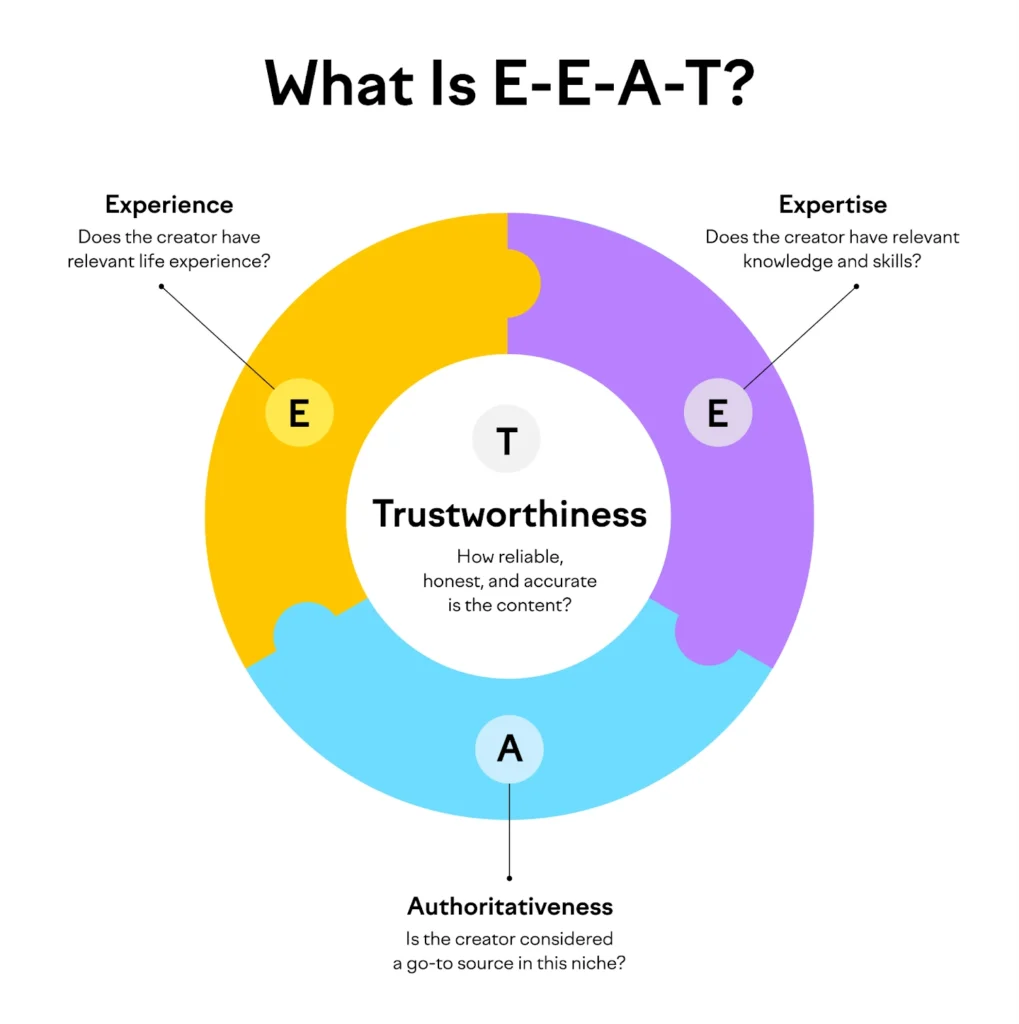
The First ‘E’: Experience (The New Kid on the Block)
This “E” is the most recent addition, and frankly, it’s the one that really knocks out cheap AI content. Google is looking for first-hand involvement. Did you actually do the thing you’re writing about?
For instance, a writer detailing a software setup without showing a screenshot of their actual logged-in dashboard? That lacks experience. A travel piece about Rome where the author mentions the best quiet café they found off the main tourist drag—that’s experience talking.
You prove this by adding un-faked details. Show the chipped mug in your photo, mention the weird glitch you ran into, or use language that reflects actual immersion. It adds texture that algorithms simply can’t generate.
Expertise: Do You Hold the Keys to the Kingdom?
This is about knowing the material cold. If you’re discussing quantum physics, I expect you to sound like you’ve got a PhD, or at least that you’ve consulted with someone who does.
For us content creators, this means transparency about who wrote it. I hate seeing great content posted anonymously. Who is the person behind the keyboard? We must prominently feature author bios that aren’t just fluff—show the certifications, list the years in the field, maybe even link to a LinkedIn profile where their professional history is locked down tight. It’s about showing your papers!
Authoritativeness: Being the One People Quote
Expertise is what you know; Authority is external validation. It’s about your reputation out in the digital wild. Are other respected voices pointing to you as the source?
This is often where people conflate things. No, paying for links doesn’t build genuine authority; that’s just borrowing someone else’s street cred temporarily, and Google hates that game. Real authority comes from creating something so genuinely useful that other established sites naturally want to reference it. It’s like having a popular local diner—people recommend it because the food is consistently stellar, not because the owner paid for flyers. We need those credible backlinks from relevant sources.
Trustworthiness: The Glue That Holds It All Together
If I could pick one element that’s always mattered most, it’s Trust. You can be the most experienced guy in the room, but if your website looks like it was built in 1998 with sketchy pop-ups, readers—and Google—will bolt.
It’s the unglamorous stuff: HTTPS encryption, a clear “About Us” page, easy-to-find contact info, and making sure your published data is spot-on. When you’re dealing with YMYL (Your Money or Your Life) topics—say, investment advice—the trust bar shoots through the roof. A mistake there can actually harm someone, so Google demands absolute certitude and transparency.
How to Write Like a Human Who Knows Their Stuff
So, we’ve mapped the philosophy. Now, let’s talk process—how do we actually write this way?
Strategy 1: Intent-First Structure
Always start with a rigorous analysis of user intent. If the search query is “best CRM for small business” (commercial intent), your structure must feature comparison tables, pros/cons, and clear “Buy Now” sections.
If the query is “why do my feet hurt while running” (informational intent), your H2s must map directly to diagnostic questions, building toward a solution rooted in experience.
Strategy 2: Injecting Human Rhythm
This is where the humanized tone shines. After drafting, run a quick self-audit:
- Check for Stiff Transitions. Replace robotic connectors like “Furthermore,” “Moreover,” or “In conclusion” with natural speech starters like, “But here’s the catch,” or “So, what does that actually mean?”
- Use Active Voice. Passive voice sounds academic and distant. Active voice sounds like you taking action: “I tested this setup” (Active) versus “This setup was tested by me” (Passive).
- Embrace Contractions. Use “don’t,” “we’ll,” they instantly make the reading feel tighter and more direct. We want that nice, varied rhythm; a couple of short, punchy sentences followed by a more detailed, thoughtful explanation. It mimics natural speech patterns—that’s burstiness in action.
Strategy 3: Leveraging Entities and Topical Authority
Google understands topics through entities (people, places, concepts) mentioned in the text. Content Mastery means touching upon all relevant entities. If you write about SEO, you must mention entities like John Mueller, PageRank, Core Web Vitals, and Schema Markup.
By linking these concepts contextually, you map your article as being deeply knowledgeable about the entire SEO entity, not just a single keyword.
Wrapping Up: Building Content That Sticks
If you take away just one thing from this, let it be this: Stop chasing Google’s symptoms and treat the disease. The disease is low-quality, impersonal content. The cure is Content Mastery driven by authentic E-E-A-T signals.
When you shift your entire focus from “What keyword volume can I capture?” to “What genuine value can I deliver based on my experience here?”, you naturally start hitting all the required checkpoints—technical precision meets compelling, human narrative. That’s when the high rankings arrive, and more importantly, that’s when they stay.
The Authority Google Ranking Factor: Backlinks and Reputation
Think of this section as your site’s reputation in the real world. Content gets you in the game, but authority is what determines your seating at the winner’s table. Google doesn’t just read your words; it looks around the web to see who else is vouching for you.
This is the realm of Off-Page SEO, and frankly, it still holds massive sway over the competitive keyword set you’re aiming for.
Backlinks: The Non-Negotiable “Votes of Confidence”
A backlink, which is just a link from another website to yours, is the original currency of the internet, born from the old PageRank algorithm. And you know what? It’s still one of the strongest Google Ranking Factors out there. But the whole link-building game has fundamentally changed.
It’s no longer about getting a thousand low-quality links from spammy blog comments or directories. That’s a fast track to a penalty, plain and simple. Today, it’s Quality over Quantity. A single, relevant, editorial link from a recognized industry leader or a major news site (imagine a link from Forbes mentioning Zumeirah’s expertise) is worth more than a lifetime supply of random blog comments.
These links are “votes of confidence,” signaling to Google, “This site is trustworthy and authoritative.” The quality of your Quality Backlinks profile often determines if you can leapfrog a competitor in the SERPs. It’s that simple, yet that hard to execute without the right strategy.
Assessing Link Quality: Relevance, Trust Flow, and Velocity
When evaluating backlinks, we focus on three things: Relevance (is the linking site in a related industry?), Trust Flow (how authoritative and trusted is the linking site, based on metrics like Domain Authority or Domain Rating?), and Velocity (is the pace of acquiring links natural, or did you suddenly get 500 links in a week?). A human-like, sustainable Link Building Strategy is crucial for long-term success with these Google Ranking Factors.
We also have to be smart about Anchor Text Strategy. If dozens of sites link to your service page using the exact phrase “Google Ranking Factors service,” that looks unnatural and manipulative. Instead, we aim for natural variations and branded anchors (like “Zumeirah’s SEO team”) to signal genuine, organic reputation building.
The Power of Brand and Entity Recognition
Google is smart enough to know that real businesses are actually talked about, whether or not they get a direct hyperlink. That’s where Brand Signals and entity recognition come into play. Having a robust Google Business Profile (GBP) and consistent NAP (Name, Address, Phone) data across the web is essential, especially for local relevance, even if your services are global.
- Brand Mentions: If people are discussing Zumeirah on social media, in forums, or on industry news sites, even without linking, Google sees that as a powerful signal of a real-world entity with authority.
- Review Content: For service-based businesses, leveraging client testimonials and industry reviews is essential. This builds trust directly with prospective clients and indirectly with Google’s algorithm, which uses aggregated sentiment signals. Having consistent, positive feedback across platforms signals high Trustworthiness, directly boosting your E-E-A-T score.
This pillar is all about reputation management and strategic visibility. It’s what transforms a good website into a trusted industry brand.
The User-Centric Google Ranking Factor: Page Experience and Core Web Vitals

Imagine searching for an answer, clicking a link, and then… waiting. The page slowly loads, text jumps around, and finally, frustrated, you hit the back button. That negative interaction? Google sees it, and it definitely factors into your ranking. This is why Page Experience, the technical quality of your site, is a crucial pillar. It’s the technical bridge that connects your great content to a happy user.
Decoding Core Web Vitals (CWV): Speed is UX
Core Web Vitals are three metrics that measure real-world user experience based on speed, responsiveness, and visual stability. They are non-negotiable Google Ranking Factors because they directly impact how a user feels about your site—and how often they stick around.
- LCP (Largest Contentful Paint): This measures load speed. How long until the main content block is visible? It has to be fast. If your page takes three seconds to show the primary article text, you’ve already lost the battle, haven’t you? Optimizing image sizes and removing unnecessary render-blocking CSS are common fixes here.
- FID (First Input Delay): This measures responsiveness. How long until the browser can actually process a user’s interaction, like a click or tap? If a user clicks a menu item and nothing happens, that’s poor FID. (Heads up: FID is transitioning toward INP (Interaction to Next Paint), which measures all page interactions, emphasizing the need for ultra-responsive web design).
- CLS (Cumulative Layout Shift): This measures visual stability. Have you ever tried to click a button and suddenly an ad loads, shifting the whole page? That frustrating shift is CLS, and Google absolutely hates it because it ruins the experience. Fixing this often involves properly reserving space for elements (like images or embeds) before they load.
User Engagement: Dwell Time and Click-Through Rate (CTR)
Google’s sophisticated machine learning systems, like RankBrain, continuously monitor user interactions with your search snippets and content. When a user clicks your link, a timer starts.
- Dwell Time: How long do they stay on your page? If they stay for five minutes to read your entire article, that’s high Dwell Time—a clear signal that your content was highly relevant and satisfying.
- Bounce Rate: If they hit the back button immediately, that’s a “pogo-sticking” action—a high Bounce Rate signals low relevance.
- CTR (Click-Through Rate): This metric starts even before the user visits. Does your title tag and meta description compel them to click over the competition? High CTR is a massive, positive UX Ranking Factor, indicating your content is perceived as the best choice available.
All of this ties back to Mobile-Friendly design. Since the mobile-first indexing shift, your phone performance is the baseline for your desktop ranking. If your site is sluggish or clunky on a small screen, you simply won’t rank well.
The Foundational Google Ranking Factors: Technical SEO and Crawlability
Imagine trying to build a magnificent mansion (your amazing content and authority) on sand. It won’t last, will it? That’s what happens when you neglect Technical SEO. This pillar ensures Google’s crawlers can actually find, read, understand, and categorize your site efficiently, allowing your superb content to finally be seen. This is the mechanical integrity of your path to the top.
Site Structure and Internal Linking: The Map to Value
Your website needs a clear, logical architecture. Think of it like a massive library: everything must be categorized and easy to find. This is often achieved through a silo structure or pillar/cluster models—where comprehensive pillar pages (like this one on Google Ranking Factors) link strategically to smaller, related cluster articles.
Why is this so important?
- Crawlability: It helps Googlebot efficiently map your content.
- Authority Distribution: Internal Linking passes PageRank (link equity) to your most important pages. For Zumeirah, we use this linking strategy to ensure your main SEO Service Page receives the maximum link equity from high-authority articles like the one you’re reading now.
- Discovery: It helps fix “Orphan Pages” (content that exists but has no internal links pointing to it), otherwise they become invisible to Google.
Security, Crawlability, and Schema Markup
These three elements are the non-negotiable details of a successful website, the kind of boring-but-crucial stuff we handle during a rigorous Technical SEO Audit.
- HTTPS Requirement: This isn’t just a signal anymore; it’s a prerequisite. Having an SSL certificate to ensure a secure connection is mandatory. Google actively favors secure sites, making Website Security a baseline Google Ranking Factor. If you don’t have the lock icon, you’re penalized. Simple as that.
- Crawl Budgets: For larger sites, Google allocates a limited amount of resources (its Crawl Budget) to visit your pages. We need to direct Googlebot efficiently using tools like the
robots.txtfile and XML sitemaps, ensuring it spends time on your revenue-driving pages, not low-value administrative pages.
Enhancing SERP Appearance with Structured Data
Structured Data (Schema Markup) is literally the language you use to tell Google what your content means. By implementing the correct schema—for articles, reviews, services, or FAQs—you enhance your SERP appearance, often resulting in rich results (like star ratings or quick facts).
This dramatic visual enhancement improves your CTR (a major ranking factor, remember?), which directly influences your ranking potential.
From Knowledge to #1 Results
We’ve walked through the four foundational pillars of modern SEO: Content, Authority, Experience, and Technical Foundation. As you can see, the path to the #1 Search Results is complex, requiring expertise in everything from high-level copywriting and user psychology to web development and data analytics.
Mastering all the Google Ranking Factors means juggling those demanding E-E-A-T standards, ensuring flawless Core Web Vitals, nurturing high-quality backlink profiles, and maintaining perfect technical integrity. It’s a massive, continuous, and highly demanding effort.
Most businesses simply don’t have the specialized in-house team or the thousands of hours required to execute this flawlessly month after month.

You have the knowledge—now it’s time for expert execution. At Zumeirah, we don’t just follow the rules; we immerse ourselves in algorithm changes daily to build and maintain your competitive advantage. Ready to stop guessing and partner with experts who apply these Google Ranking Factors every single day to achieve #1 Search Results? Explore Zumeirah’s comprehensive SEO services and start dominating your niche today.
We offer a free, no-obligation technical audit to diagnose your site’s biggest ranking roadblocks. Let’s talk strategy and see how quickly we can move your business to the top.