

If you’re still trying to rank on Google by chasing high-volume keywords and sprinkles of backlinks, you’re basically playing a 2018 game in a 2026 world. Have you noticed how the search results look lately?
Between the AI Overviews taking up half the screen and those ultra-smart “conversational” answers, the old playbook is essentially gathering dust.
Here’s a stat that actually kept me up last night: nearly 60% of searches now end without a single click. You heard that right. People are getting their answers directly from the AI at the top of the page. So, if nobody is clicking, how does a brand like Zumeirah or yours actually survive?
The answer isn’t just “more content.” It’s topical authority.
You know what? I used to tell clients that SEO was about being the “best answer.” But in 2026, it’s about being the “only expert.”
When you build topical authority, you aren’t just ranking for a single phrase like “what is topical authority.” You’re proving to Google’s semantic brain that you own the entire conversation around a subject.
It’s the difference between a student who memorized a fact and a professor who lived the research.
Let’s get real for a second. Google doesn’t look for words anymore it looks for entities and intent. This is where semantic SEO comes in. It’s the engine under the hood.
While topical authority is the “reputation” you build, semantic SEO is the technical way we talk to machines so they understand that reputation. They work together like a high-end chef and a perfectly organized kitchen. Without both, you’re just serving fast food in a five-star market.
Honestly, the goal here isn’t just to get you a #1 spot. It’s to make your website so authoritative that Google feels it has to show your content to keep its users happy.
Ready to stop renting space on page two and start owning the neighborhood? Let’s break down what this actually looks like in practice.
What is Topical Authority in Modern SEO?
If you ask five different SEOs to define topical authority, you’ll probably get six different answers and a long-winded debate about backlinks. But when you strip away the jargon and the complexity, it’s actually pretty simple.
Think about your local mechanic. If you go in because your brakes are squeaking and he starts talking to you about the history of the internal combustion engine, the chemistry of synthetic oil, and the best way to maintain your brake pads all without breaking a sweat and you trust him. You don’t just think he knows about “brakes”; you see him as an authority on “cars.”
That’s exactly what topical authority is in the eyes of a search engine. It’s not about having one lucky page that ranks for a single keyword. It’s about Google looking at your entire website and saying, “Yeah, these people actually know what they’re talking about.”
It’s the perceived expertise and credibility you earn by covering a specific topic so thoroughly that there are no questions left to ask.
Core Components: Depth, Relevance, and E-E-A-T
Most people think they can just write ten blog posts and call it a day. But in 2026, the bar is a lot higher. To really own a topic, you have to nail these three components:
- The Depth of Coverage: This is where most brands fail. They go an inch deep and a mile wide. If you’re writing about Search Engine Optimization, you can’t just talk about “how to rank.” You have to talk about the messy stuff like crawling budgets, edge SEO, and how AI agents interpret your header tags. You have to leave no stone unturned.
- Relevance (The “Stay in Your Lane” Factor): If a high-end fashion blog suddenly starts giving advice on cryptocurrency, Google gets confused. Topical authority is about staying focused. It’s about making sure every piece of content on your site strengthens the others.
- The E-E-A-T Equation: You’ve probably heard this acronym a thousand times, but it’s more critical now than ever. Experience, Expertise, Authoritativeness, and Trustworthiness. Google wants to see that the person writing the content has actually “done the thing.” It’s about showing your work, citing your sources, and proving you’re a real human with real knowledge.
Real-World Examples of Websites with Strong Topical Authority
You don’t have to look far to see topical authority in action. Take Healthline, for example. Whether you’re searching for “how to fix a headache” or “complex neurological disorders,” they are everywhere.
Why? Because they’ve spent years building a library of content that is medically reviewed, deeply researched, and interlinked so perfectly that Google views them as the ultimate authority on health.
Or look at Investopedia. They don’t just define “stocks.” They cover everything from the psychological triggers of day trading to the tax implications of offshore accounts. They’ve mapped out the entire world of finance. When you land there, you don’t feel the need to go back to the search results to check another site. You’ve found the source.
Here’s the thing: you don’t need a multi-million dollar budget to do this. You just need to be more helpful and more detailed than the person currently sitting at the top of the page. Honestly, it’s about being the most generous teacher in your niche.
The Evolution of Topical Authority in SEO
If you’ve been in the SEO trenches for more than a minute, you probably remember the “Golden Age” of keyword stuffing. You’d pick a word, mention it 50 times in a 500-word post, and you were on page one.
Honestly? It was a mess. It was bad for users, but it worked because search engines were basically just giant librarians looking for matching text strings.
But those days are long gone. Search engines stopped reading words and started understanding ideas.
From Keyword Stuffing to Semantic Search (2013–2021)
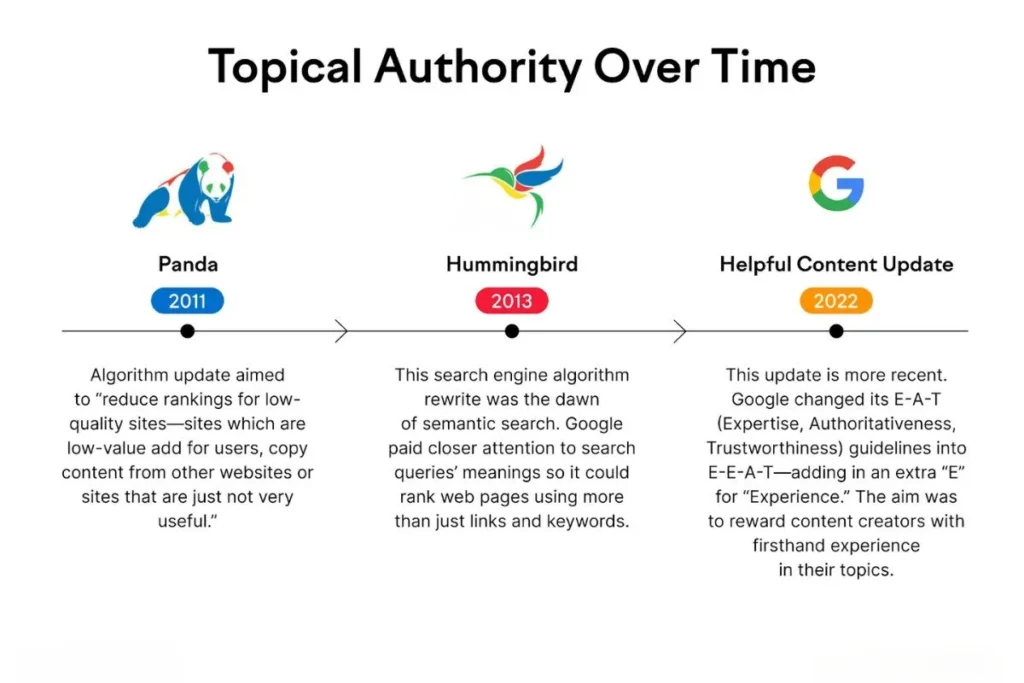
Everything changed with Google Hummingbird back in 2013. That was the first time the algorithm tried to understand the meaning behind a query rather than just the keywords. Fast forward to 2019, and BERT took it to another level, using natural language processing to grasp the context of words.
Then came MUM (Multitask Unified Model) in 2021, which can literally look at text, images, and videos across 75 languages to figure out the answer to a complex question.
This evolution was all leading up to one thing: Entity-based SEO. Google isn’t looking for “best running shoes”; it’s looking for the entity “Running Shoes” and assessing which website is the most trusted source for that entire topic.
Major Google Updates That Changed the Game
If 2021-2023 was the era of AI-generated noise, 2024 and 2025 were the years of the “Great Quality Reset.” We saw massive shifts with the Helpful Content System and the March 2025 Core Update. Google basically decided to stop playing nice with “thin” content that was clearly written by machines for machines.
If your site was just a collection of generic articles, it probably got hit. Hard. Why? Because Google started prioritizing “Information Gain.” It’s no longer enough to be correct; you have to be new.
You have to offer a perspective or a data point that isn’t already living in 10,000 other search results. This is where topical authority became the survival kit for brands like Zumeirah.
What Topical Authority Means in the AI Search Era (2024–2026)
So, where are we now? Welcome to the world of AI Overviews (you might still call it SGE) and GEO (Generative Engine Optimization).
In 2026, the game is no longer just about ranking #1 in the blue links. It’s about being the source that the AI cites in its summary. When a user asks a complex question, the AI scans the web for the most authoritative “expert.” If you haven’t built deep topical authority, you simply won’t exist in that AI-generated response.
Here is what the 2026 landscape looks like:
- Zero-Click Results: More people are getting their answers directly on the SERP. If you want a click, your content needs to offer something the AI summary can’t like a deep-dive case study or a nuanced opinion.
- Voice Search & AI Assistants: Whether it’s Gemini, Siri, or a smart home device, these assistants only give one answer. They don’t give you a list of ten links. They pick the “Topical Authority” and read that out loud.
- Semantic Consistency: The AI is looking for consistency across your site. If you’re an expert on “Web Design” on one page but sound like an amateur on the next, the “Trust” signal breaks.
Honestly, it’s a bit of a high-stakes game. But for those who take the time to build a cohesive, expert-driven content ecosystem, the rewards are bigger than ever. You aren’t just getting traffic; you’re building a brand that AI engines literally can’t ignore.
Why Topical Authority Is More Important Than Ever in 2026
If you’re wondering why everyone in the SEO world is suddenly obsessed with being an “authority” instead of just ranking for “keywords,” you’re not alone.
Honestly, it’s because the ground has shifted beneath our feet. In 2026, the traditional search engine results page (SERP) looks more like a curated intelligence report than a list of links.
Google Ranking factors used to be a checklist. Title tag? Check. H1? Check. Keyword mentioned three times? Check. But today, Google’s Helpful Content Update has evolved into a system that sniffs out “thin” content like a bloodhound.
If you’re just rehashing what everyone else is saying, you’re not just failing to rank then you’re becoming invisible.
Better Rankings in AI Overviews and Generative Search
The biggest reason topical authority matters right now is the rise of AI Overviews. When a user asks a complex, nuanced question, Google doesn’t just want a page that has the right words. It wants a source it can trust to summarize the entire topic.
AI engines are essentially looking for “professors,” not “students.” If your site covers every corner of a niche like from the basic definitions to the weird, technical edge cases so you become the logical choice for that AI citation.
This is the new organic traffic growth engine. Being the cited source in a generative answer is worth more than five #1 rankings for random keywords because it positions Zumeirah as the definitive expert.
Increased Organic Traffic and User Trust
Let’s get real about traffic for a second. We’ve all seen sites that get 100,000 visitors a month but make zero sales. Why? Because the content doesn’t match the user intent.
When you build deep topical authority, you’re naturally doing better user intent matching. You’re answering the questions people didn’t even know they had yet. This does two very cool things for your bottom line:
- It slashes your bounce rate: If someone lands on your page about “Semantic SEO” and sees a sidebar with links to your guides on “Entity Mapping” and “Schema for 2026,” they aren’t going back to Google. They’re staying on your site.
- It triples your conversion potential: According to recent data, visitors arriving via AI referrals or authoritative deep-dives are often worth up to 4x more from a conversion perspective. Why? Because you’ve already done the hard work of proving you know your stuff. They trust you before they even see your “Contact Us” page.
Statistics: How Topical Sites Perform in 2025–2026
I’m usually skeptical of “marketing stats,” but some recent reports are hard to ignore. Ahrefs and Semrush data from late 2025 shows that sites utilizing a “Topic Cluster” model like the foundation of topical authority see an average of 40% higher visibility compared to sites using isolated, keyword-heavy posts.
Even more striking? A case study recently highlighted in industry circles showed that focusing on topical depth rather than keyword volume led to a 60% increase in organic traffic within just six months for a mid-sized niche site. Honestly, it’s about the compounding interest of content. One good post is a spark; a topic cluster is a bonfire.
“The most successful SEO strategies today are those that prioritize depth over density. In 2026, if you aren’t the expert, you’re the noise.”
We’re moving away from a world where we “optimize for Google” and toward a world where we “optimize for expertise.” It’s a bit more work upfront, but the staying power you get is unmatched.
You won’t be sweating every time there’s a minor algorithm tweak because your authority is built on substance, not shortcuts.
Topical Authority vs Other SEO Concepts
If you’ve spent any time reading SEO blogs lately, you’ve probably noticed that we love our acronyms and metrics. It’s enough to make your head spin. You’ve got DA, PA, DR, and now everyone is shouting about Topical Authority. Honestly, it feels like people just keep inventing new ways to say “make your website better.”
While these concepts often get lumped together, they’re doing very different jobs. If you want to rank in 2026, you need to know which lever you’re actually pulling. Let’s break down the differences so you don’t waste time chasing the wrong numbers.
Topical Authority vs. Domain Authority
I see this mix-up all the time. People think that if they have a high domain authority, they can rank for anything. That might have been true five years ago when a handful of “super-sites” dominated every search result. But today? Not so much.
Think of Domain Authority (DA) as a resume. It’s a broad look at your site’s overall strength, mostly built on the back of your link profile. It’s a great way to see how “powerful” a site is in general. But topical authority vs topical expertise is a different beast entirely. Topical authority is your reputation for a specific subject.
I’ve seen niche sites with a DA of 20 absolutely destroy massive brands with a DA of 80 in the search results. Why? Because the small site covered every single nuance of a topic, while the giant only had one shallow article. Google’s 2026 algorithms are smart enough to realize that being a “big” site doesn’t make you an expert on everything.
Topical Authority vs. Page Authority
Then we have page authority. This is the old-school way of thinking: “How do I make this one page rank for this one keyword?” It’s very narrow. You focus on that specific URL, you get some exact-match keywords in the title, and you hope for the best.
But topical authority is about the forest, not just the tree. Instead of looking at a single page in isolation, it looks at your topic clusters. It’s about how your “Pillar” guide on SEO connects to your “Spoke” articles on keyword density, technical audits, and link building.
When you build authority across a cluster, every page in that group gets a boost. It’s a “rising tide lifts all boats” situation. If you only optimize one page, you’re basically a one-hit-wonder. Google wants to see a full discography.
Topical Authority vs. Semantic SEO
This is where it gets a little more technical, but stick with me. People often use these terms interchangeably, but they aren’t the same.
- Topical Authority is the outcome. It’s the status you achieve when Google recognizes you as a leader in a niche.
- Semantic SEO is the methodology. It’s the strategy you use to get there.
Semantic SEO is how we talk to Google’s AI. It’s about using NLP (Natural Language Processing) to identify the entities means the “things” rather than the “strings” and that define your topic.
If you’re writing about “Zumeirah,” semantic SEO helps Google understand that we’re a brand, we’re located in the UAE, and we provide SEO Services as well. It’s about intent matching and context.
Honestly, you can’t have one without the other. You use semantic SEO techniques to prove your topical authority. It’s the difference between saying “I’m an expert” and actually showing the complex relationships between the ideas you’re discussing.
Why “Keyword Counting” is a Relic of the Past
Here’s a quick reality check: stop worrying about keyword density. Just stop. In 2026, the idea of “3% density” is about as relevant as a floppy disk. Google doesn’t need to see the same word repeated over and over to know what your page is about.
In fact, if you’re still using exact-match keywords in every heading, you’re probably hurting your rankings.
Modern search is conversational. It’s about meaning. If you write naturally about a topic, you will naturally include the related terms that Google expects to see.
If you’re an expert, you won’t have to “try” to include keywords; they’ll just be there because that’s how experts talk.
How Topical Authority Powers Semantic SEO
You know what’s funny? A lot of people treat “Topical Authority” and “Semantic SEO” like two different items on a menu. But in reality, they’re more like the engine and the fuel. You can’t really have one doing its job without the other.
Understanding Semantic SEO in 2026
Keywords are just labels. If I search for “Mars,” am I looking for the planet, the chocolate bar, or the Roman god? A decade ago, Google would just guess based on the words around it.
But today, through the lens of contextual relevance, the search engine isn’t just looking at the word; it’s looking at the related entities on your site to figure out who you are and what you actually know.
The Role of Entities, Context, and User Intent
When you build topical authority, you aren’t just ranking for a list of semantic keywords. You are essentially building a mini knowledge graph right on your own domain.
Think of your website as a map. Every article is a landmark (an entity), and every internal link is a road connecting them. If you only have one landmark, Google doesn’t really know where you are.
But if you have fifty landmarks all related to “Dubai Web Design,” Google’s AI starts to understand the entire landscape of your expertise. It stops seeing “strings” and starts seeing “things.”
This is where the magic happens for user search intent. When your site covers every angle from the “how-to” guides to the deep technical breakdowns then you’re telling the algorithm that you understand the user’s journey.
You aren’t just trying to sell them something but you’re answering the questions they haven’t even thought to ask yet. That’s how you win the trust of a machine that is increasingly programmed to value “helpfulness” over everything else.
Connection Between Topic Clusters and Semantic Signals
If you’re still only thinking about what people type into a search bar, you’re missing half the picture. By 2026, the way we interact with information has completely fractured.
- The Rise of AI Chatbots: Tools like Gemini and ChatGPT don’t just “search” the web; they “read” it. They are looking for authoritative sources to synthesize into a conversational answer. If your content is structured around a strong topical cluster, you’re making it incredibly easy for these AI agents to pick you as the primary source. Honestly, it’s about making your data “machine-digestible.”
- Voice Search and Natural Dialogue: People don’t talk in keywords. They don’t say “SEO UAE.” They ask, “Who is the best expert for SEO in Dubai?” Topical authority ensures that when a voice assistant looks for the answer, your site is the most relevant entity in that specific geographical and professional niche.
- Multimodal Content: Here’s a bit of a digression, but it matters: Google’s AI can now “see” and “hear” your content. If you have a video that explains a concept and an infographic that breaks down the data, you’re providing multiple “entry points” for the algorithm. It’s not just about the text anymore; it’s about the total sensory experience of your expertise.
The goal of semantic SEO isn’t to “trick” Google into thinking you’re an expert. It’s to provide so much value and such a clear structure that the algorithm has no choice but to recognize the reality of your authority. You’re not just matching a query; you’re fulfilling a need.
Strategies to Build Topical Authority for Semantic SEO in 2026
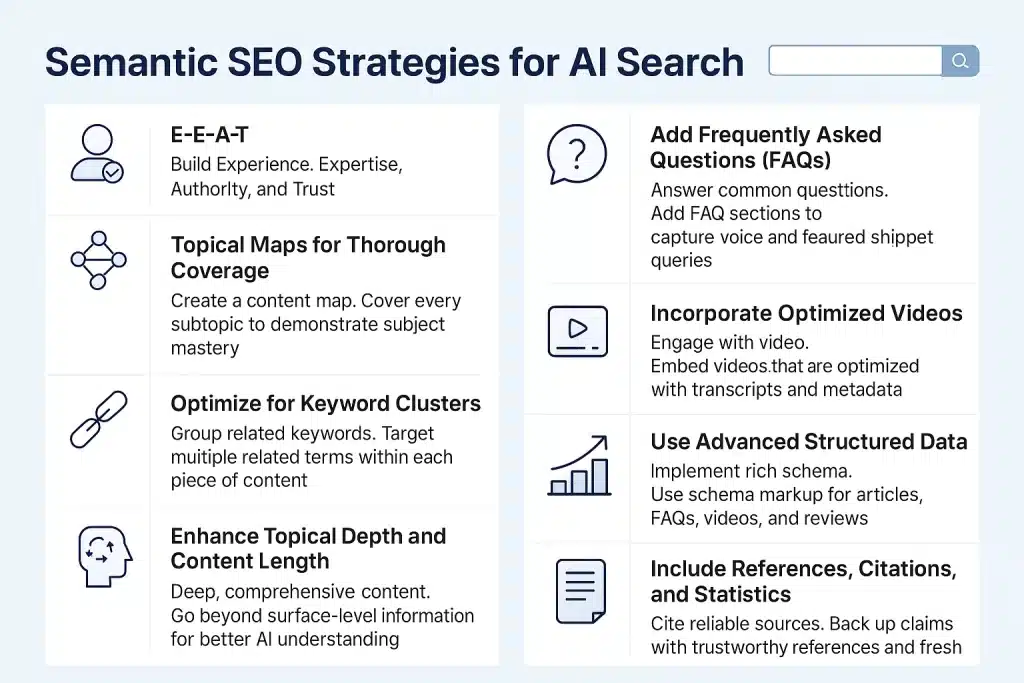
Building topical authority isn’t just about writing a lot; it’s about writing smart. If you’re aimlessly publishing posts without a cohesive structure, you’re just adding noise to an already crowded internet.
In 2026, Google’s algorithms are looking for a “knowledge map” on your site, not just a list of articles.
You need to treat your website like a digital library where everything is perfectly categorized and easy to find. Let’s break down the actual steps to make that happen.
1. Advanced Topic-Based Keyword Research (2026 Edition)
Forget the old way of looking for a single high-volume keyword and calling it a day. Today, you need to think in terms of entity optimization.
I start every project by looking at the “People Also Ask” sections and using tools like Semrush Keyword Magic or Ahrefs Keywords Explorer to find semantic keywords that relate to my core subject. You aren’t just looking for “web design”; you’re looking for “UI/UX principles for 2026,” “mobile-responsive frameworks,” and “Core Web Vitals for Dubai businesses.”
- Long-tail keywords: These are your secret weapon. They might have lower volume, but the intent is much higher.
- Entity Mapping: Identify the people, places, and concepts (entities) that Google associates with your niche and make sure they are present in your content.
2. Planning and Mapping Perfect Topic Clusters
This is where the magic happens. You need to organize your site into content hubs.
Think of a pillar content page as the “Main Station.” It’s a comprehensive guide that covers a broad topic in detail. Then, you have your cluster pages (the “Spoke” lines) that dive into specific, narrow sub-topics.
For example, if your pillar is “The Ultimate Guide to SEO,” your cluster pages might be “How to do a Technical Audit” or “The Role of Backlinks in 2026.”
Using a mind map or a tool like Surfer SEO’s Topical Map helps you visualize this. It ensures you don’t have any “orphaned” pages that aren’t connected to the rest of your expertise.
3. Creating High-Quality, Future-Proof Content
Honestly, if you’re just using AI to churn out 500-word blog posts, you’re going to get buried. Google’s helpful content update is designed to reward original research and expert insights.
- Multimedia is non-negotiable: Include custom infographics, videos, and unique images. It keeps people on the page longer and signals to Google that you’ve put in the work.
- AI Ethics: Use AI for brainstorming and outlining, but let a human (or an expert writer like me!) handle the nuance and the “voice.” Google can tell the difference between a bot and a person who actually knows their stuff.
4. On-Page Semantic SEO Optimization Techniques
This is the technical “handshake” between your content and the search engine. You need to use structured data and schema markup to tell Google exactly what your page is about.
Most people skip this because it looks like “code,” but it’s essential. By using FAQPage or Article schema, you’re helping Google’s knowledge graph connect your site to the right topics.
And don’t forget internal linking. Use descriptive anchor text avoid “click here” to show the relationship between your pillar and your spokes.
5. Building Topical-Relevant Backlinks & Signals
In the age of AI search, backlink relevance is more important than quantity. One link from a high-authority site in your specific niche is worth more than a hundred links from random blogs.
- Digital PR: Get featured in industry publications.
- The “Citation” Strategy: In 2026, being mentioned in an AI Overview is the new backlink. Focus on being so authoritative that AI engines have to cite you.
6. Leveraging AI Tools & New Technologies for Authority
Don’t fear the tech just use it. Use AI to find “content gaps” where your competitors aren’t providing enough detail.
Are you prepared for voice optimization? People ask questions differently when they speak. They say, “Hey Google, how do I build topical authority?” rather than typing “topical authority strategy.” Your content needs to answer those natural, conversational queries.
7. Content Maintenance & Freshness Strategy
SEO isn’t a “set it and forget it” game. You need to maintain content freshness.
Honestly, I recommend a quarterly audit. Check your top-performing pages. Is the data still accurate? Is there a new trend in 2026 you should mention? A simple update can often do more for your rankings than writing an entirely new post.
Best Tools & Resources for Topical Authority in 2026
You can have the best strategy in the world, but if you’re trying to build a 2026-grade website with 2010 tools, you’re going to have a hard time. It’s a bit like trying to build a skyscraper with a hand saw.
You might eventually get there, but the guy with the power tools is going to finish six months before you and probably do a better job.
The good news? The “power tools” for SEO have never been better. We’ve moved past simple trackers and into a world where software can actually “understand” your content almost as well as a human can.
Here is a look at the keyword research tools and optimization platforms that are actually worth your time.
Free Tools Every SEO Should Still Use
You don’t always need a massive budget to get started. In fact, some of the best data comes straight from the source.
- Google Search Console (GSC): This is your most honest friend. It tells you exactly what people are typing to find you. In 2026, I use it primarily to find “near-miss” opportunities like keywords where I’m ranking on page two but haven’t fully covered the topic yet.
- AlsoAsked and AnswerThePublic: These are pure gold for uncovering PAA questions (People Also Ask). If you want to build authority, you have to answer the questions your audience is actually asking. These tools give you a visual map of the “who, what, where, and why” of your niche.
- Google Trends: Essential for seeing if a topic is gaining steam or if it’s a “flash in the pan.” You know what? It’s better to build authority on a rising trend than a dying one.
Premium Tools That Give You an Edge
When you’re ready to get serious about topical maps, you’ll probably find yourself looking at the big three: Semrush, Ahrefs, or Surfer SEO.
- Ahrefs: Still the king of backlink data, but their “Content Explorer” and “Site Audit” tools are becoming much more semantic. They’ve added features that help you see where your competitors have “clusters” that you’re missing.
- Semrush: I love their “Keyword Magic Tool” for its sheer volume of data. It’s great for finding those “neighboring” topics that help you round out a pillar page.
- Surfer SEO: If you’re a writer, this is usually the go-to. It gives you a real-time “Content Score” based on how well you’re hitting the semantic requirements of the top-ranking pages. It tells you exactly which terms to include and how often to stay competitive.
Emerging AI-Powered Topical Analysis Tools
This is where things get really interesting. We’re seeing a new breed of content optimization tools that focus on entity extraction and semantic depth rather than just keyword counts.
- MarketMuse: This is an enterprise-level tool that basically builds a “Subject Matter Expert” model for you. It compares your site against the entire web and tells you, “Hey, an expert would also talk about X, Y, and Z.” It’s the ultimate tool for avoiding “thin” content.
- InLinks: These guys are pioneers in entity optimization. They help you build a schema-rich internal linking structure that tells Google’s Knowledge Graph exactly how your pages are related. It’s highly technical, but for a site like Zumeirah, it’s a massive competitive advantage.
- Clearscope: Known for its simplicity and “human-first” approach. It uses IBM Watson’s NLP to help you ensure your writing is covering the most important concepts without sounding like a robot.
I always tell people to start with one or two tools and master them. Don’t get “shiny object syndrome.” The goal isn’t to own every tool; it’s to use the data from these tools to create something that actually helps people.
At the end of the day, Google doesn’t rank you because you used Ahrefs; it ranks you because your content is the most authoritative.
Common Mistakes That Kill Topical Authority in 2026
Even the smartest SEOs trip over their own feet sometimes. Building topical authority isn’t about perfection; it’s about avoiding the “silent killers” that can sink your rankings before you even get a chance to swim.
If you’re putting in the work at Zumeirah, the last thing you want is a avoidable penalty or a messy site structure that confuses Google’s semantic brain.
Let’s get real about what actually goes wrong when people try to scale their authority too fast.
Focusing on Quantity Instead of True Depth
I see this every single week. A brand decides they want to “own” a topic, so they churn out 50 blog posts in a month. But here’s the thing: they’re all 400 words long, they all say the same thing, and none of them actually solve a problem.
This is what we call thin content. In 2026, Google doesn’t reward you for being loud; it rewards you for being helpful. If you have ten incredible, deep-dive guides, you will outrank someone with a hundred shallow posts every time.
Honestly, it’s better to publish nothing than to publish something that adds zero value to the conversation.
Ignoring User Intent & Semantic Relevance
This is a technical one, but it’s a massive mistake. You might rank for a keyword, but if the content doesn’t match the user search intent, people will bounce faster than a rubber ball.
For example, if someone searches for “how to fix a slow WordPress site,” they want a tutorial. If your page is a 2,000-word essay on the history of PHP, they’re going to leave. You’ve “covered the topic,” but you haven’t matched the intent. Google sees that high bounce rate and thinks, “Okay, this site isn’t actually an authority on this.” You lose.
Poor Internal Linking Structure
This is where your own pages start fighting each other for the same keyword. It’s called content cannibalization, and it’s a mess.
If you have three different articles all trying to rank for “best SEO tools,” Google gets confused. It doesn’t know which one to prioritize, so it often ends up ranking none of them well.
Instead of spreading your authority thin, you should merge those pages into one “Mega-Guide” or clearly distinguish them (e.g., “Free SEO Tools” vs. “Paid SEO Tools”).
Over-Reliance on AI Content Without Human Touch
Look, AI is great for outlines and research. But if you’re letting a bot write your entire strategy, you’re essentially ignoring E-E-A-T.
AI can’t share a personal story about a client project that went sideways. It can’t give a nuanced opinion on a controversial industry trend.
In 2026, the “human touch” is actually a ranking factor. Google is looking for Experience. So the one thing a machine doesn’t have. If your site sounds like a textbook, you’re going to get replaced by the AI summary at the top of the page. You want to be the source the AI cites, not the thing it replaces.
The “Island” Effect (Neglecting Internal Links)
You can write the best article in the world, but if it doesn’t link to anything else on your site, it’s an island. Internal linking is the bridge that carries authority from your pillar pages to your smaller posts.
Without a clear internal structure, Google’s crawlers have a hard time understanding how your topics are related. Plus, it’s bad for the user journey.
You want to lead people down a rabbit hole of your expertise. If they finish one article and have nowhere to go, they leave. That’s a wasted opportunity to build trust.
Forgetting the “Modern” Basics
It’s 2026, if your site isn’t lightning-fast on a phone, your authority doesn’t matter. Period. Mobile/voice optimization is no longer “extra credit”; it’s the bare minimum.
Most people are asking their AI assistants questions while they’re on the go. If your content isn’t structured to answer those natural, conversational queries, you’re missing out on a huge chunk of the market. Honestly, if you’re still writing long, unbroken walls of text, you’re basically asking people to click away.
Avoid these traps, and you’re already ahead of 90% of your competitors. It’s about being deliberate, being human, and keeping your site organized.
Frequently Asked Questions About Topical Authority
When I’m talking to clients at Zumeirah, I get asked the same five or six questions about authority every single week. People are usually worried they’ve missed the boat or that they’re too small to compete with the giants. So, let’s clear the air and address the things that are probably on your mind right now.
What is the difference between topical authority and E-E-A-T?
This is easily the most common point of confusion. Think of them as two sides of the same coin, but they’re doing different jobs.
E-E-A-T (Experience, Expertise, Authoritativeness, and Trustworthiness) is how Google measures the credibility of the person or brand behind the content. It’s about your credentials, your real-world experience, and whether you’re a safe source of information.
Topical authority, on the other hand, is about the depth of your content. It’s the proof that you’ve covered every single nook and cranny of a specific subject.
You can have great E-E-A-T (like a doctor writing an article), but if you only have one article on your whole site, you don’t have topical authority yet.
Authority is built over time through your content hubs and the sheer volume of helpful, interlinked information you provide. In short: E-E-A-T is who you are; Topical Authority is what you’ve proven you know.
How long does it take to build topical authority in 2026?
If someone tells you that you can “hack” authority in two weeks, they’re lying. In 2026, Google’s semantic brain is faster than ever, but it still takes time to earn trust.
Generally, for a brand-new domain, you’re looking at 6 to 12 months of consistent, high-quality publishing before Google truly recognizes you as a “niche king.” If you have an existing site and you’re just pivoting to a new topic, you might see results in 3 to 6 months.
The “2026 variable” here is AI. Because the internet is being flooded with mediocre AI content, Google has actually slowed down its trust-building process for new sites to filter out the noise.
However, if you use a solid FAQ schema strategy and answer PAA questions (People Also Ask) better than anyone else, you can accelerate this by hitting those “low-hanging fruit” queries first.
Can small websites actually achieve topical authority?
Absolutely. In fact, being small is often an advantage. Giant sites like Search Engine Land have to be authorities on everything in the marketing world. That’s a massive job.
As a smaller player, you can “niche down” and own a very specific corner of the market. You might not be the authority on “Global Marketing,” but you can absolutely be the #1 authority on “Web Designing for Sharjah Business.”
By covering that specific niche with topical depth metrics that the big guys can’t match like local case studies and hyper-specific technical guides and then you become the “go-to” source. Google loves a specialist.
How does AI impact topical authority strategies?
AI has completely flipped the script. It used to be that we optimized for “clicks.” Now, we’re optimizing for Generative Engine Optimization (GEO).
When tools like Gemini or ChatGPT look for an answer, they aren’t just looking for a keyword; they’re looking for a “source of truth.”
By building topical authority, you’re essentially training these AI models to see Zumeirah as a primary source. If you have a clear knowledge graph on your site (thanks to structured data and schema markup), AI assistants are much more likely to cite your content in their summaries.
Honestly, the goal in 2026 isn’t just to rank but it’s to be the source that the AI trusts enough to quote.
What metrics indicate that I actually have strong topical authority?
Stop looking at your overall “Domain Rating” for a second. That’s a vanity metric. If you want to know if you’re winning the authority game, look at these instead:
- Keyword Footprint Growth: Are you starting to rank for related questions and long-tail terms that you didn’t even specifically target? That’s a sign that Google understands your “topic” and is giving you credit for the whole niche.
- AI Citation Rate: How often is your brand appearing in AI Overviews? This is the new “Position Zero.”
- Topical Authority Ratio: This is a simple but powerful one. It’s the percentage of your site dedicated to a specific topic versus the total number of pages. If 80% of your content is about one thing, you’re an authority. If it’s only 5%, you’re just a generalist.
- Internal Link Equity: Are your “spoke” pages starting to rank well simply because they’re linked to your “pillar” page? That’s authority in action
Conclusion: Your Path to Niche Dominance
From the messy history of keyword stuffing to the ultra-smart, entity-driven world of 2026. If there’s one thing I want you to take away from all of this, it’s that the future of SEO isn’t about trying to outsmart an algorithm. It’s about becoming so obviously expert in your field that Google would be doing its users a disservice by not ranking you.
This feels like a lot more work than just picking a keyword and writing a 500-word post. And honestly? It is. But that’s exactly why it works.
Most of your competitors are still looking for shortcuts. They’re still trying to “hack” the system with thin content and mechanical backlink strategies. While they’re busy chasing shadows, you can be busy building authority online that actually lasts.
The 2026 Semantic Success Checklist
Before you close this tab and get back to your day, let’s quickly recap the heavy hitters for your strategy:
- Stop thinking in keywords; start thinking in topics. Map out your niche like a professor, not a marketer.
- Build those clusters. Your pillar pages are the foundation, but your supporting content is what proves your depth.
- Talk to the machines (and the humans). Use schema markup and structured data so AI agents can easily cite Zumeirah as the source of truth.
- Be the expert. Share real stories, real data, and real opinions. That’s the “Experience” in E-E-A-T that AI can’t replicate.
It’s a Marathon, Not a Sprint
Here’s the thing about SEO trends 2026: they all point toward “sustained effort.” You won’t wake up tomorrow with 100,000 visitors just because you added one internal link.
But if you spend the next few months consistently filling in the gaps in your topical map, the results will start to compound.
Think of it like building a house. Every high-quality cluster you add is another brick. Eventually, you have a structure that is solid enough to withstand any algorithm update Google throws your way. You won’t be sweating over every core update because your foundation isn’t built on tricks like it’s built on substance.
Your Next Move
So, where do you start? Honestly, don’t try to do everything at once. Start with an audit. Look at your existing content and ask: “Is this helpful, or is it just noise?”
Identify your core pillar and start mapping out the 10 or 20 sub-topics you need to cover to truly own that space. If you’re ready to stop guessing and start growing, now is the time to get serious about your topic clusters.